

Microorganisms are the most abundant life forms on Earth, present in almost every ecosystem on the planet, from the deepest depths of the sea to our own digestive systems. Humans have long harnessed these tiny organisms to make food: for example, yeast has been used to make bread and ferment beer for millennia.
Today, microorganisms offer an important approach to addressing one of our most pressing challenges: how to meet growing global demand for high-quality protein, without the environmental cost of expanding industrial animal agriculture. Biomass fermentation is a promising emerging solution.
What is biomass fermentation?
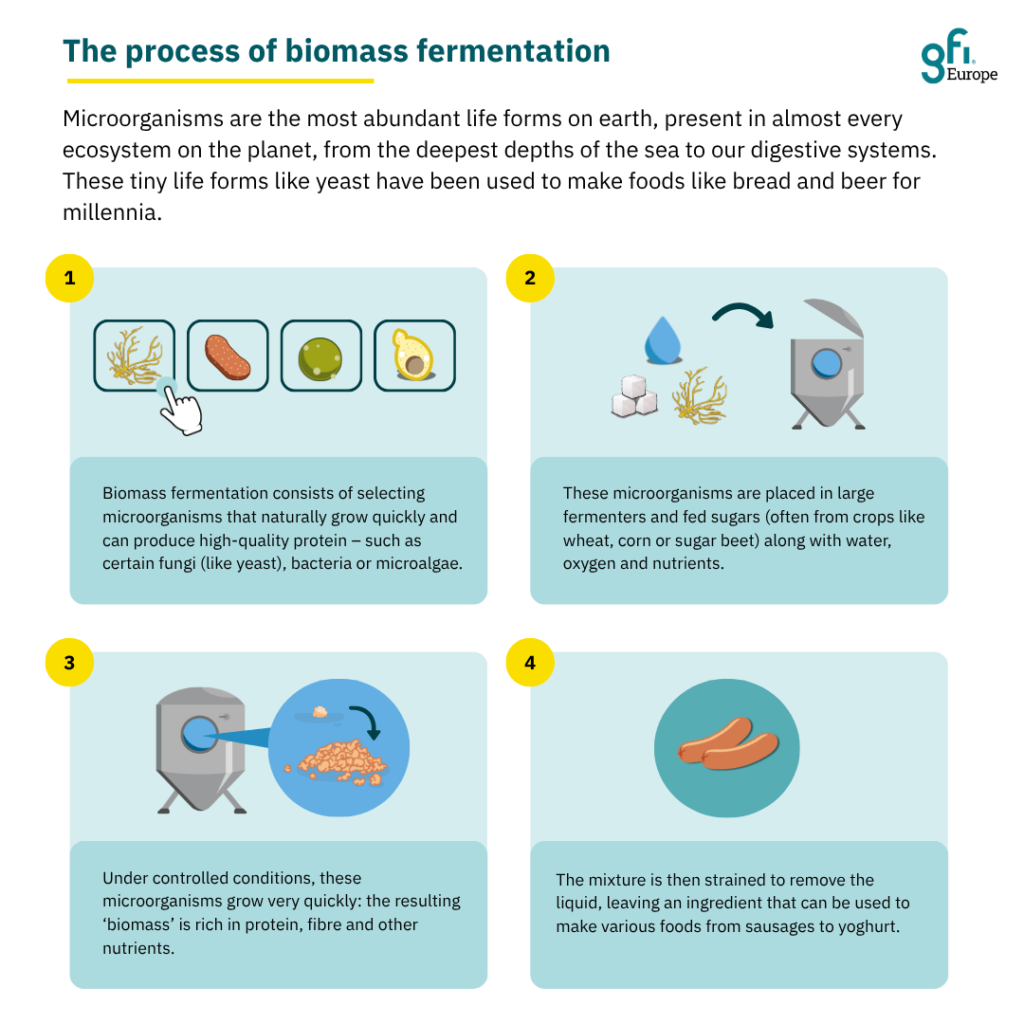
Biomass fermentation is a process through which microorganisms – such as fungi like yeast, algae like spirulina, or bacteria – rapidly grow or multiply, producing large quantities of high-quality protein. There are various approaches to achieving this, using different feed stocks and microorganism strains, but the process below is the most commonly used.
These microorganisms are placed in large fermentors and fed sugars (often from crops like wheat, corn or sugar beet) along with water, oxygen and nutrients.
Under controlled conditions, these microorganisms grow very quickly: the resulting biomass is rich in protein, fibre and other nutrients.
The mixture is then strained to remove the liquid, leaving an ingredient that can be used to make various foods from sausages to yoghurt. If a fungi was used as the base species, this ingredient is broadly referred to as mycoprotein.
Depending on the microorganism chosen for the fermentation process, biomass protein can be used as the main ingredient, or as a secondary ingredient to enhance the overall properties of another product.
While this is the most common approach, there are various innovative approaches seen across Europe spanning a huge range of feedstocks and strains – for example, Finland’s Solar Foods produces biomass using a similar process, but their chosen microorganism can harness carbon dioxide from the air as its main feedstock, alongside select vitamins and minerals added to the fermenter. Instead of sugars or sunlight, as used by animals and plants, this species has evolved to use hydrogen gas as its energy source, which is produced from water in the fermentor using electricity.
What is the history of biomass fermentation?
Tempeh, a traditional food from Indonesia, uses techniques similar to biomass fermentation to grow nutritious fungi through soy beans, a practice dating back over 400 years. Yet it wasn’t until the 20th century that this approach began to take off in Europe.
In the mid-1800s, famous German scientist Justus von Liebig discovered a process for producing yeast extract from spent brewers’ yeast. In 1902, the Marmite Food Extract Company partnered with a local UK brewery to develop this into a nutritious, high-protein bread spread. The spread grew in popularity within the UK, and was even used as a nutritional supplement during the First World War. This would be the first widespread use of biomass fermentation for food in Europe.
In the aftermath of the Second World War, flour company owner Arthur J Rank commissioned research to develop a tasty, nutritious protein source capable of feeding the world’s rapidly growing population. After analysing over 3,000 fungal strains from around the globe, the filamentous fungi Fusarium venenatum, which had been collected from one of the researcher’s gardens, was identified as the most promising candidate.
Marlow Foods went on to develop this discovery into mycoprotein, which received approval for human consumption in the UK in 1985 and is still sold today under the Quorn brand.
In recent years, as climate impacts and supply chain volatility have underscored the importance of protein diversification, interest in biomass fermentation has grown considerably. Across Europe, many researchers and start-ups are exploring the potential of microorganisms to produce sustainable, nutritious and tasty protein ingredients. New research into biomass fermentation is investigating more strains and fermentation approaches, while also revisiting older techniques – including local adaptations of tempeh-style fermentation, such as growing mushroom mycelium on oats.
Germany today stands as a clear case study for the potential of this new focus on biomass fermentation, home to diverse start-ups using different approaches to develop protein-rich meat alternatives. Some of these include Infinite Roots and MicroHarvest from Hamburg, Nosh.bio and KultFarm from Berlin, ProteinDistillery from Ostfildern, and Kynda from Jelmstorf.
The German example also highlights the potential for this to benefit traditional food producers. Breweries, for example, are well suited to biomass fermentation. In Germany, several companies are leveraging these synergies through partnerships with breweries – for example, Infinite Roots, Eat Beer, and Nosh.bio.
What is the difference between biomass fermentation and precision fermentation?
Both biomass and precision fermentation use microorganisms and fermentors, but they serve different purposes.
In biomass fermentation, the microorganism itself is what the resulting ingredients are made from.
In precision fermentation, the microorganism is used as a tiny factory to produce an ingredient. It’s given the instructions to produce a specific compound, such as a protein, enzyme or fat. The end product is not the microorganism itself, but the specific ingredient it was instructed to make. Precision fermentation has already been used in Europe for decades to produce rennet, an enzyme used to make cheese. In recent years, however, new applications are being explored to offer more resilient sources of ingredients like whey protein, chocolate and palm oil.
What are the environmental benefits of biomass fermentation?
Compared with conventional animal agriculture, biomass fermentation has a significantly lower environmental footprint, for various reasons:
Land use
Conventional animal agriculture requires vast amounts of land – mostly for grazing and animal feed – which drives deforestation. By contrast, microorganisms grown in fermentors require very little physical space. According to a Carbon Trust report, producing 1kg of beef mince requires 13-16 times more land than a kg of mycoprotein mince, and pork sausages require 4.7-12 times more than mycoprotein sausages. By reducing land use pressure, fermentation can help satisfy protein demand while leaving space for sustainable and regenerative farming.
Greenhouse gas emissions
Animal agriculture is a major source of methane and other greenhouse gases. The Carbon Trust report found that 1kg of beef mince produced 20-27 times more greenhouse gas than 1kg of mycoprotein mince, and 1kg of pork sausages produced 7-8 times more greenhouse gas than 1kg of mycoprotein sausages. The energy used to power the fermentors is the main driver of fermentation’s carbon footprint, so ensuring the use of renewable energy would make the process even more sustainable.
Water
Fermentation often requires less water than raising animals for food. For instance, producing 1kg of beef mince requires 2.5-17.8 times more water than producing 1kg of mycoprotein mince, and 1kg of pork sausages requires 1.8-2.5 times more water than a mycoprotein equivalent.
Circularity
A key area of promise for biomass fermentation is the capacity of microorganisms to use feedstocks that currently go to waste, such as spent brewers’ grain from beer brewing or pressed oilseeds leftover from producing vegetable oil. By utilising side streams, start-ups can fit within existing supply chains and create new revenue streams for primary agricultural producers. In this way, biomass fermentation can contribute to the circular economy and grow without having to build entirely new supply chains from scratch, while also strengthening the resilience and efficiency of the food system.
How is biomass fermentation regulated in Europe?
Biomass fermentation to produce foods using species we have eaten for many years, such as yeast, spirulina, koji, and mycoprotein from Fusarium venenatum, do not need new approvals and are increasingly used in Europe for new biomass fermentation applications. However, if a company uses a new species, strain or production process, this generally requires a new authorisation before it can be sold in Europe.
In the EU, the pre-market authorisation is governed by the Novel Foods Regulation. Once EU regulators approve a biomass fermentation product or ingredient, it can be sold across all 27 member states. The approval process includes a thorough and evidence-based assessment of the safety and nutritional value and is estimated to take at least 18 months, though in practice it can take several years. Countries outside the EU, such as the UK and Switzerland, have their own similar regulatory frameworks in place.
Within Europe, the most established product in this space is Quorn’s mycoprotein, which has been widely consumed for decades and predates the current regulatory framework. More recently, The Protein Brewery’s Fermotein became the first novel mycoprotein to receive authorisation in the EU under the Novel Foods Regulation, having already secured regulatory approvals in the United States and Singapore.
How can European governments help biomass fermentation ingredients enter the mainstream?
Biomass fermentation has a long history in Europe, which is home to leading researchers and startups in the field. Public funding is also beginning to grow at both the national and EU levels. However, governments need to invest more to expand research and innovation, and build the infrastructure needed to help fermentation-made ingredients reach the scales necessary to enter the mainstream. At the same time, governments need to optimise regulatory processes to ensure more efficient review while maintaining Europe’s current world-leading standards, such as enabling regulators to provide extended scientific advice and detailed guidance to applicants before submission.

Learn more
Learn more about the science, business and policy of fermentation in Europe