
State of the European alternative protein research ecosystem: funding, publications and patents
Unpack the diverse research and innovation landscape for alternative proteins in Europe through the lenses of funding, publications and patents.
Overview
At the start of this decade, alternative proteins were still a relatively niche topic of research in Europe. In 2020, only 284 research papers were published involving European researchers, and funding was under €100 million.
Europe has made significant progress since then. It’s now home to research centres dedicated to accelerating alternative protein innovation. European universities host thousands of world-leading academics who published over 1,000 papers and collaborated with colleagues from 70 countries in 2025 alone. Alternative protein research has grown into an exciting field, achieving measurable progress towards making these sustainable options more appealing and affordable.
But our latest analysis shows that 2025 saw European public funding for alternative protein research fall for the first time. Investment in young fields can often fluctuate from year to year, and several countries launched long-term funding initiatives in 2023 and 2024 that will continue to make an impact for years to come. But the slowdown in investment across countries that had begun to build functioning research ecosystems is concerning, and should refocus the attention of funders. According to a recent analysis by Systemiq, to unlock the full potential of alternative proteins, governments need to invest €690 million annually in R&I across Europe. With 2025 funding standing at €236 million, Europe risks missing out on the food security, sustainability and economic benefits of protein diversification.
Recent months have yet again exposed the fragility of crucial supply chains and the urgent need to diversify our food system. Plant-based foods, cultivated meat and fermentation offer paths to resilient and efficient meat production that can reduce Europe’s reliance on imported protein. After years of growth, the alternative protein research ecosystem is in a strong position to absorb increased funding and accelerate progress. But to maintain momentum, retain expertise and realise the field’s potential, governments must redouble their investments.
European alternative protein ecosystem
Explore key findings on the European alternative protein research ecosystem below and download the full report (covering EU member states + United Kingdom + Switzerland + Norway).
Funding
Between 2020 and 2025, European funders invested €1.3 billion in alternative protein research, including €236 million in 2025.
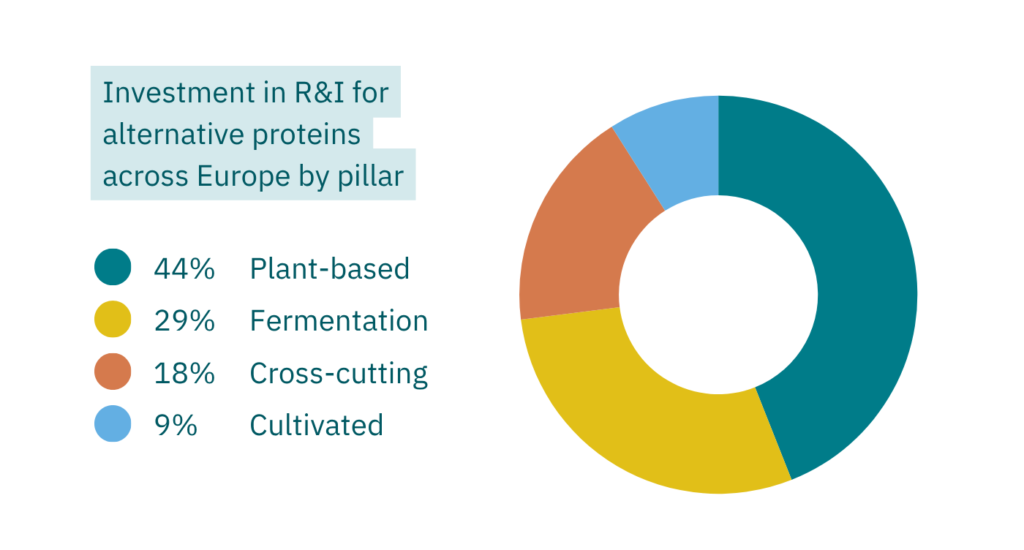
Plant-based proteins received nearly half of all investment (44%), followed by fermentation at 29%, cross-cutting topics at 18% and cultivated meat and seafood at 9%.
The top three countries for overall investment in alternative protein research (2020-2025) were Denmark at €176 million, the UK at €147 million and the Netherlands at €88 million.
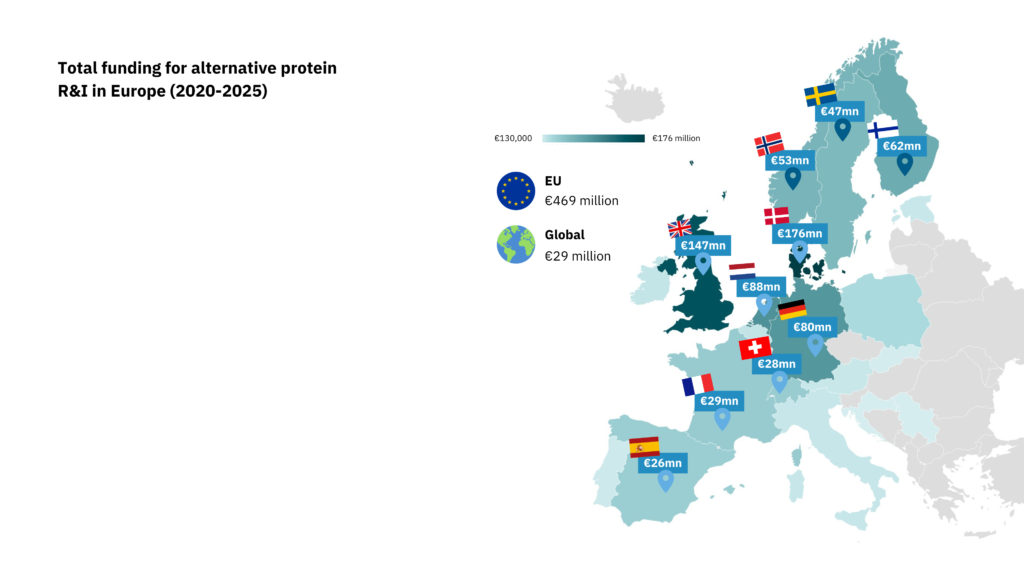
| Country | Total funding for alternative protein research and innovation (2020-2025) |
|---|---|
| Austria | €4,710,601.00 |
| Belgium | €6,600,000.00 |
| Croatia | €131,239 |
| Czechia | €3,927,424.0 |
| Denmark | €175,711,652.86 |
| Estonia | €4,631,669.00 |
| Finland | €61,787,889.00 |
| France | €28,586,802.00 |
| Germany | €79,708,963.00 |
| United Kingdom | €147,119,880.90 |
| Ireland | €5,945,906.60 |
| Netherlands | €87,794,918.00 |
| Norway | €52,837,339.56 |
| Poland | €14,529,390.47 |
| Portugal | €2,804,806.00 |
| Serbia | €149,995 |
| Spain | €26,030,151.00 |
| Sweden | €47,248,440.29 |
| Switzerland | €28,142,931.79 |
| Slovakia | €511,169.00 |
| EU | €468,513,130.04 |
Publications
Between 2020 and 2025, European researchers contributed to 3,783 unique publications on topics related to alternative proteins, with output growing at an average of 31% per year. Annual publications rose from 284 in 2020 to 1,094 in 2025 – a 285% increase – with 8,164 researchers across Europe contributing to this body of work.
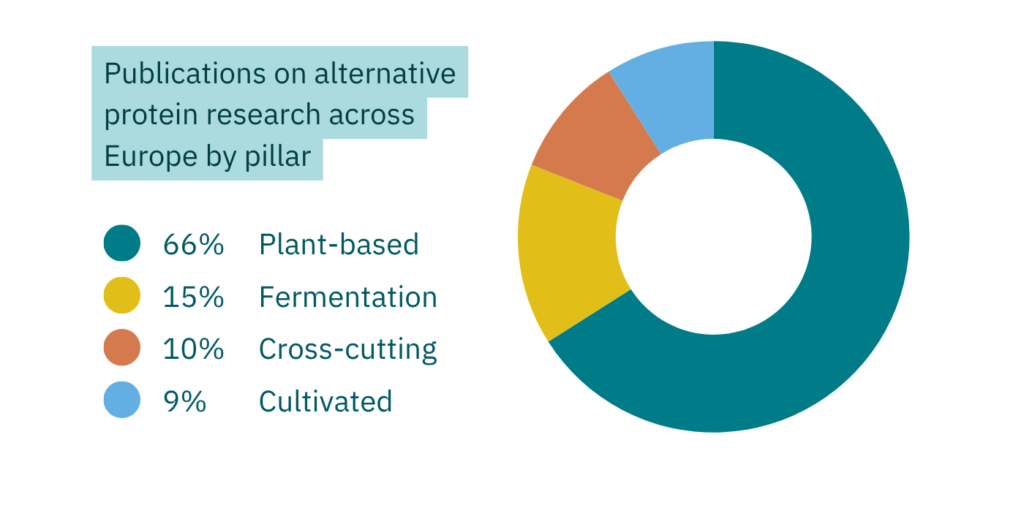
Publications were predominantly focused on plant-based proteins (66%), followed by fermentation-made proteins and ingredients (15%), cross-cutting topics (10%), and cultivated meat and seafood (9%).
Germany leads Europe, with a contribution to 13.5% of publications, followed by the Netherlands (13.1%) and the UK (12.8%).
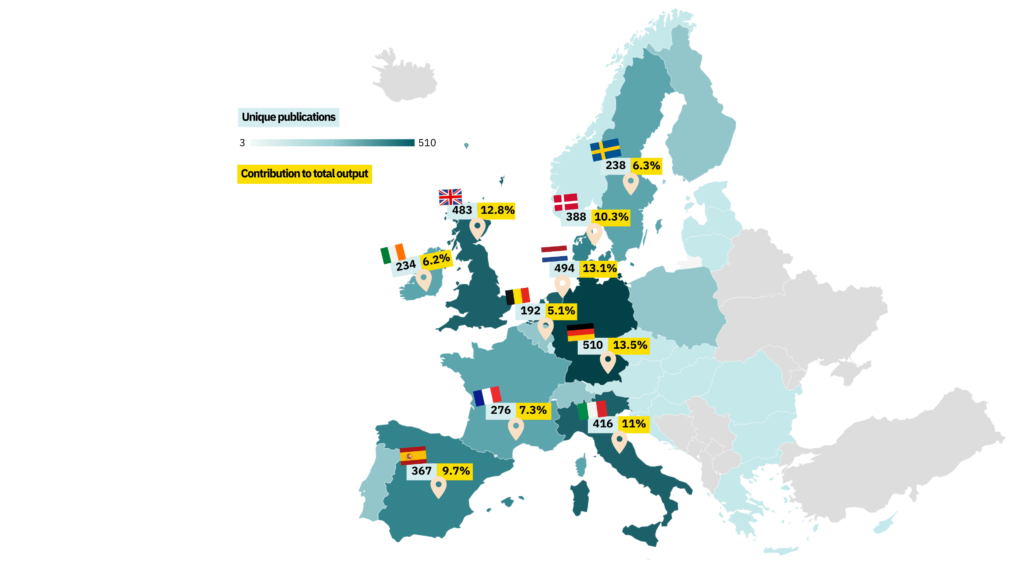
| Country | Total unique publications | Contribution to total output |
|---|---|---|
| Germany | 510 | 13.5% |
| Netherlands | 494 | 13.1% |
| United Kingdom | 483 | 12.8% |
| Italy | 416 | 11.0% |
| Denmark | 388 | 10.3% |
| Spain | 367 | 9.7% |
| France | 276 | 7.3% |
| Sweden | 238 | 6.3% |
| Ireland | 234 | 6.2% |
| Belgium | 192 | 5.1% |
| Finland | 184 | 4.9% |
| Poland | 180 | 4.8% |
| Portugal | 173 | 4.6% |
| Switzerland | 158 | 4.2% |
| Norway | 69 | 1.8% |
| Greece | 66 | 1.7% |
| Austria | 65 | 1.7% |
| Hungary | 39 | 1.0% |
| Romania | 35 | 0.9% |
| Czechia | 32 | 0.8% |
| Lithuania | 21 | 0.6% |
| Latvia | 16 | 0.4% |
| Croatia | 16 | 0.4% |
| Slovenia | 15 | 0.4% |
| Estonia | 13 | 0.3% |
| Slovakia | 13 | 0.3% |
| Bulgaria | 13 | 0.3% |
| Malta | 6 | 0.2% |
| Luxembourg | 4 | 0.1% |
| Cyprus | 3 | 0.1% |
Patents
Between 2015 and 2025, European alternative protein innovators published 7,452 patents. Patent publications surged by 1,124% between 2015 and 2025, with an average year-on-year growth rate of 31%.
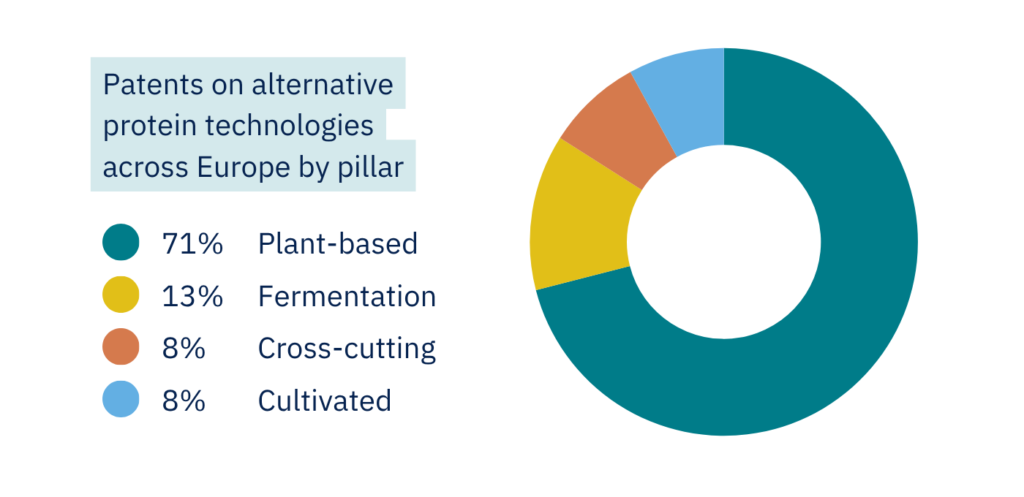
Patents were predominantly focused on plant-based proteins (71%), followed by fermentation-made proteins and ingredients (13%), with cultivated meat and seafood and cross-cutting topics each accounting for 8%.
Switzerland led with 21.7% of all patent families, followed by the Netherlands (15%) and Germany (14.8%).
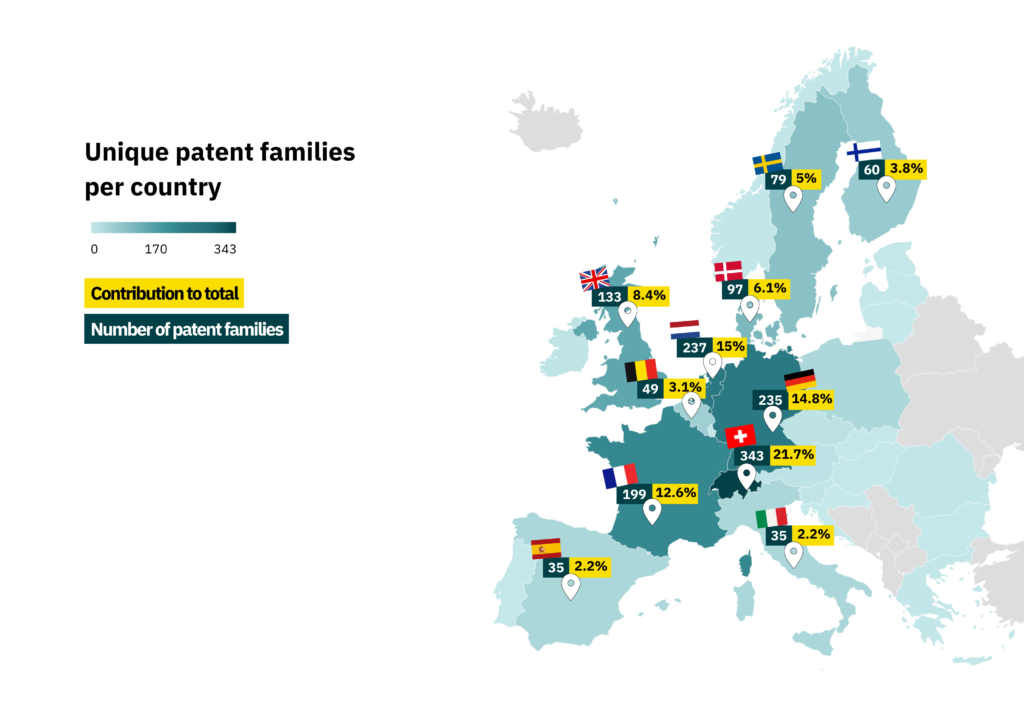
| Country | Total unique patent families | Contribution to total output |
|---|---|---|
| Switzerland | 343 | 21.7% |
| Netherlands | 237 | 15.0% |
| Germany | 235 | 14.8% |
| France | 199 | 12.6% |
| United Kingdom | 133 | 8.4% |
| Denmark | 97 | 6.1% |
| Sweden | 79 | 5.0% |
| Finland | 60 | 3.8% |
| Belgium | 49 | 3.1% |
| Italy | 35 | 2.2% |
| Spain | 35 | 2.2% |
| Poland | 32 | 2.0% |
| Czechia | 12 | 0.8% |
| Austria | 9 | 0.6% |
| Ireland | 8 | 0.5% |
| Slovenia | 6 | 0.4% |
| Romania | 4 | 0.3% |
| Norway | 3 | 0.2% |
| Greece | 3 | 0.2% |
| Estonia | 2 | 0.1% |
| Luxembourg | 2 | 0.1% |
| Bulgaria | 2 | 0.1% |
| Hungary | 1 | 0.1% |
| Portugal | 1 | 0.1% |
| Cyprus | 1 | 0.1% |
| Slovekia | 1 | 0.1% |
| Latvia | 1 | 0.1% |
| Lithuania | 0 | 0.0% |
| Croatia | 0 | 0.0% |
| Malta | 0 | 0.0% |
Regional deep-dives
Explore key insights on alternative protein research (publications, patents and funding) and download the full deep dives for the following regions: EU, Denmark, Finland, France, Germany, Netherlands, Spain, Sweden, and the United Kingdom.
EU institutions
- The European Commission allocated €469 million to alternative protein research between 2020 and 2025, with a 213% increase between 2015 and 2025. More than 40% of this funding came from Cluster 6.
- Researchers in EU member states contributed 3,221 publications on alternative proteins between 2020 and 2025, reflecting an average annual growth of 33% and an overall increase of 306% over the period.
- Innovators based in the EU published 5,366 patents between 2015 and 2020, with a 940% increase over the period.
Cite this resource: Stella, C., Hunt, D., & Good Food Institute Europe. (2026). State of the alternative protein research and innovation ecosystem in the European Union, 2020-2025. Good Food Institute Europe. https://doi.org/10.5281/zenodo.20124084
Denmark
- The Danish government invested €24 million in alternative protein research between 2020 and 2025 – placing it 10th among European countries. On a per capita basis, Denmark invested €4 per person, placing it joint-fourth alongside Sweden.
- Denmark contributed 388 publications on alternative proteins between 2020 and 2025, ranking fifth for publication volume across Europe, with output growing by 461% over the period.
- Leading research-performing institutions include Aarhus University (146 publications), the University of Copenhagen (119), and the Technical University of Denmark (114), which are ranked second, third, and fourth in Europe, respectively, for total publications in the period 2020-2025.
- Innovators based in Denmark published 433 patents between 2015 and 2025, ranking sixth in Europe for both published patent volume and unique patent families. On a per capita basis, Denmark ranked second only to Switzerland in terms of unique patent families.
Finland
- The Finnish government invested €62 million in alternative protein research between 2020 and 2025, ranking fourth in Europe. On a per capita basis, Finland led Europe – investing €11 per person.
- Finland contributed 184 publications on alternative proteins between 2020 and 2025, ranking 11th for publication volume across Europe – reflecting a 100% increase over the period.
- Leading research institutions include the University of Helsinki (104 publications), the VTT Technical Research Centre of Finland (54), and the Natural Resources Institute Finland (38). The University of Helsinki ranked sixth overall for publication volume in the period 2020-2025.
- Innovators based in Finland published 412 patents between 2015 and 2025, ranking seventh in Europe for published patent volume, closely behind Denmark (433) and eighth for unique patent families.
Cite this resource: Child, S., Hunt, D., & Good Food Institute Europe. (2026). State of the alternative protein research and innovation ecosystem in Finland, 2020-2025. Good Food Institute Europe. https://doi.org/10.5281/zenodo.20142051
France
- The French government invested €29 million in alternative protein research between 2020 and 2025, placing it seventh among European countries. On a per capita basis, France ranked 14th at under €1 per person.
- France contributed 276 publications on alternative proteins between 2020 and 2025, ranking seventh for publication volume across Europe and reflecting an average annual growth of 26% and a 185% increase over the period.
- Leading research-performing organisations include INRAE (43 publications), AgroParisTech (30) and Laboratoire Biopolymères Interactions Assemblages (28).
- Innovators based in France published 1,010 patents between 2015 and 2025, ranking third in total patent volume across Europe and fourth in unique patent families.
Cite this resource: Child, S., Hunt, D., & Good Food Institute Europe. (2026). State of the alternative protein research and innovation ecosystem in France, 2020-2025. Good Food Institute Europe. https://doi.org/10.5281/zenodo.20143921
Germany
- The German government invested €79 million in alternative protein research between 2020 and 2025, placing it third among European countries. However, on a per capita basis, Germany ranked 10th at €1 per person. While Germany is leading Europe in government funding for plant-based research, it is lagging behind other countries in fermentation and cultivated meat research, but it is slowly beginning to embrace these platforms.
- Germany contributed 510 publications on alternative proteins between 2020 and 2025 – the highest total output in Europe – reflecting an average annual growth of 30% and a 256% increase over the period.
- Leading research-performing organisations include the University of Hohenheim (105 publications), the Technical University of Munich (63), and the German Institute of Food Technologies (57). Of the top 100 most productive European institutions in alternative protein research, 10 are in Germany – placing it joint second with Spain and behind only the UK. The University of Hohenheim ranked sixth overall for publication volume in the period 2020-2025.
- Innovators based in Germany published 828 patents between 2015 and 2025, ranking fourth in total patent volume across Europe and third in unique patent families.
Cite this resource: Child, S., Hunt, D., & Good Food Institute Europe. (2026). State of the alternative protein research and innovation ecosystem in Germany, 2020-2025. Good Food Institute Europe. https://doi.org/10.5281/zenodo.20143133
Netherlands
- The Dutch government invested at least €88 million in alternative protein research between 2020 and 2025, placing it second among European countries, despite available figures likely representing an underestimate. On a per capita basis, the Netherlands ranked third, investing €5 per person.
- The Netherlands contributed 494 publications on alternative proteins between 2020 and 2025, ranking second in Europe and reflecting an average annual growth of 29% and a 245% increase over the period.
- Wageningen University & Research is the dominant European institution in the field of alternative proteins. With 374 publications since 2020 – more than double that of the next most productive institution – it has held the top spot in Europe for research output every year since 2020.
- Innovators based in the Netherlands published 1,111 patents between 2015 and 2025, ranking second in total patent volume across Europe and unique patent families.
Cite this resource: Child, S., Hunt, D., & Good Food Institute Europe. (2026). State of the alternative protein research and innovation ecosystem in the Netherlands, 2020-2025. Good Food Institute Europe. https://doi.org/10.5281/zenodo.20147263
Spain
- The Spanish government invested €26 million in alternative protein research between 2020 and 2025, placing it ninth among European countries. On a per capita basis, Spain invested €1 per person.
- Spain contributed 367 publications on alternative proteins between 2020 and 2025, ranking sixth in Europe and reflecting an average annual growth of 50% and a 542% increase over the period.
- Leading research-performing organisations include Universidade de Vigo (35 publications), Universitat Politècnica de València (25), and Instituto de Agroquímica y Tecnología de Alimentos (25). Of the top 100 most-productive European research-performing organisations in alternative proteins, 10 are in Spain – placing it joint second with Germany and behind only the UK.
- Innovators based in Spain published 113 patents between 2015 and 2025, ranking 11th in total patent volume across Europe and unique patent families.
Cite this resource: Child, S., Hunt, D., & Good Food Institute Europe. (2026). State of the alternative protein research and innovation ecosystem in Spain, 2020-2025. Good Food Institute Europe. https://doi.org/10.5281/zenodo.20146496
Sweden
- The Swedish government invested €47 million in alternative protein research between 2020 and 2025, placing it sixth among European countries. On a per capita basis, Sweden ranked joint-fourth along with Denmark, investing €4 per person.
- Sweden contributed 238 publications on alternative proteins between 2020 and 2025, ranking eighth in Europe for publication volume, with output growing by 261% over the period.
- Leading research institutions include the Swedish University of Agricultural Sciences (66 publications), Chalmers University of Technology (50), University of Borås (46), RISE Research Institutes of Sweden AB (30) and Lund University (34).
- Innovators based in Sweden publish 358 patents, ranking eighth in Europe for published patent volume and seventh for unique patent families.
United Kingdom
- The UK government invested €145 million in alternative protein research between 2020 and 2025 – the highest total among European countries. On a per capita basis, the UK ranked eighth, investing €2 per person. However, the significant drop in funding in 2025, after several years of increasing funding, means the UK risks losing momentum, and the newly established academic community may struggle to secure reliable ongoing funding.
- The UK contributed 483 publications on alternative proteins between 2020 and 2025, ranking third in Europe and reflecting an average annual growth of 29% and a 246% increase over the period.
- Leading research-performing organisations include the University of Leeds (58 publications), the University of Reading (32), Marlow Foods Ltd (Quorn) (31), the University of Bath (25), and the University of Nottingham (25). Of the top 100 most productive European research-performing organisations in alternative protein research, 14 are in the UK – the highest of any country.
- Innovators based in the UK published 607 patents between 2015 and 2025, ranking fifth in total patent volume across Europe and unique patent families.
Conclusions and recommendations
Funding
To help this fledgling ecosystem truly flourish, stable public funding is key. Amid a turbulent political environment with tightening public research spending in many places, Europe-wide funding for alternative proteins fell in 2025 for the first time in several years – though fermentation research managed to buck this trend. Given the promise of plant-based and cultivated meat, they should not be neglected.
Publications
Large differences are observed in research activity across certain technology areas, particularly within cultivated meat and precision fermentation, which remain underdeveloped. Across the three pillars, the European alternative protein research community displays a lower-than-average degree of collaboration and a considerable amount of regional disparity.
Patents
Europe is home to innovators from across all sectors of society who are exploring a diverse range of technological areas and achieving exciting breakthroughs in the process. However, the recent increase in both academic output and public funding for alternative protein R&I is not yet materialising in significant increases in patent filings from public research organisations.
Researchers should:
- Engage with local and regional funders, supporting them with evidence of the field’s needs and technical roadblocks.
- Focus on applying their scientific expertise to addressing the technical bottlenecks that are holding alternative proteins back from achieving taste and price parity with animal proteins.
- Explore opportunities for international networking, such as COST Actions.
Funders should:
- Earmark stable and consistent funding for the field to allow the fledgling R&I community to stabilise and research to come to fruition.
- Continue to fund fundamental research, creating a pipeline of new technological developments.
- Address collaboration and knowledge-sharing gaps across borders.
- Offer mechanisms through which public institutions can collaborate with private industry via pre-competitive and open innovation mechanisms.
For full methods including search terms, inclusion and exclusion criteria and other technical details, please see the full technical appendix here.
Funding
Data
Data sourced from GFI’s publicly available global research funding database, the GFI Research Grants Tracker, which houses information published by funders and research conductors globally, retrieved from Dimensions.ai. Kernel Science contributed to data retrieval.
Time period
2010-2025. Data retrieved in February 2026.
Country focus
EU27 + Norway + Switzerland + UK.
Search strategy
A list of search terms was developed and Dimensions.ai results screened against predefined inclusion/exclusion criteria to identify those in scope for the study.
Grants focusing plant-based, fermentation-made, or cultivated proteins and ingredients meeting these criteria were analysed by title, recipient, funder country, pillar categorisation, end product and research sub-category.
Publications
Data
Data sourced from Dimensions, an interlinked research information system provided by Digital Science.
Time period
2020-2025. Data retrieved January 2026.
Country focus
EU27 + Norway + Switzerland + UK.
Search strategy
Complex search terms were devised that allowed us to trigger numerous publications that may be relevant to our analysis.
Search returns were screened against predefined inclusion/exclusion criteria to identify those in scope for the study.
Publications relevant to plant-based, fermentation-made, or cultivated proteins and ingredients meeting these criteria were analysed in the Dimensions Landscape & Discovery application and in spreadsheet format.
Patents
Data
Data sourced from Dimensions, an interlinked research information system provided by Digital Science.
Time period
2015-2025. Data retrieved February 2026.
Country focus
EU27 + Norway + Switzerland + UK.
Search strategy
Complex search terms were devised that allowed us to trigger numerous patents that may be relevant to our analysis.
Search returns were screened against predefined inclusion/exclusion criteria to identify those in scope for the study.
Patents relevant to plant-based, fermentation-made, or cultivated proteins and ingredients meeting these criteria were analysed in the Dimensions Landscape & Discovery application and in spreadsheet format.
Cite this resource: Child, S., Hunt, D., & Good Food Institute Europe. (2026). State of the European alternative protein research and innovation ecosystem 2020-2025. Good Food Institute Europe. https://doi.org/10.5281/zenodo.20124302
Archive
Access the previous 2020-2024 edition here.