
Germany’s High-Tech Agenda: innovation hub for alternative proteins could support economic growth
GFI Europe welcomes the fact that the German federal government has firmly anchored alternative protein sources in its High-Tech Agenda.
Dieser Artikel ist hier auch auf Deutsch verfügbar.
20 May 2026
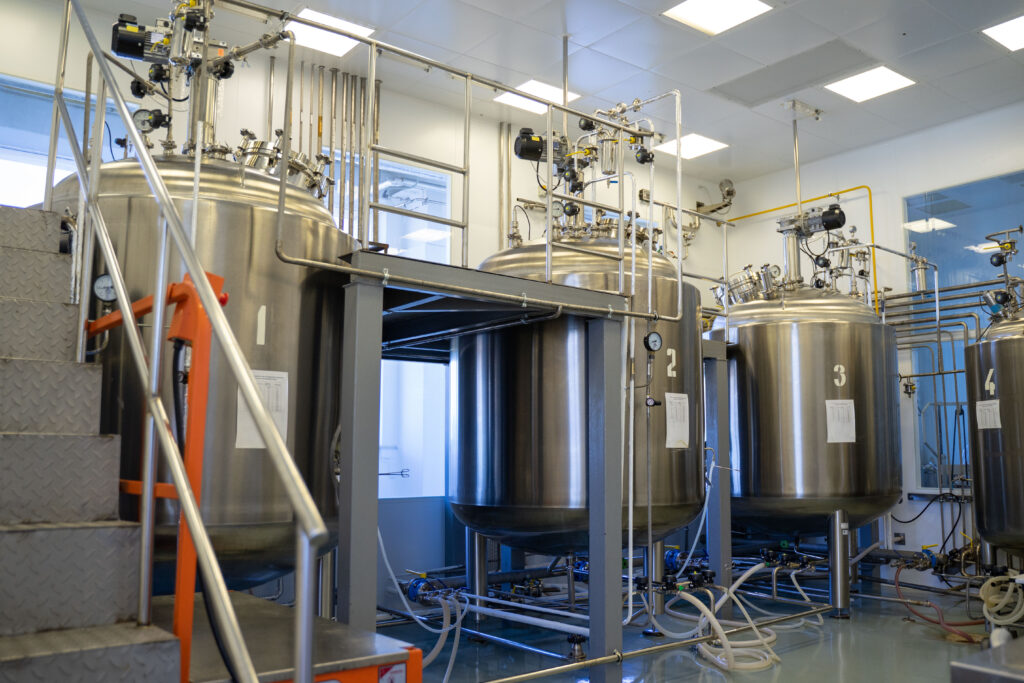
The Good Food Institute Europe (GFI Europe) welcomes the fact that the German federal government has firmly anchored alternative protein sources in its High-Tech Agenda. The Roadmap for Biotechnology, presented today by the Federal Ministry of Research, Technology, and Space, underscores the importance of alternative proteins for Germany’s innovation leadership and technological sovereignty and defines concrete measures to make the country a pioneer in this field.
Approaches such as cell cultivation and advanced fermentation hold enormous potential for the production of innovative and sustainable foods, for example, cultivated meat, or ingredients that can enhance the flavour profile and nutritional quality of plant-based meat and dairy.
Innovation hub as a catalyst for knowledge transfer between research and industry
In particular, GFI Europe welcomes the plan to establish a national innovation hub for cell cultivation and precision fermentation in 2027 in order to better consolidate previously scattered research activities, minimise duplication, and accelerate the commercialisation of research results.
Existing examples from the UK and Sweden demonstrate that such an innovation hub has the potential to significantly boost the sector. There, research institutions, industry, and policymakers are working together on openly accessible research results to accelerate progress towards delicious and affordable sustainable foods.
By embedding alternative proteins in the high-tech agenda, the federal government is beginning to close a gap in the German funding landscape: An analysis of the R&I ecosystem published by GFI Europe shows that Germany is well positioned to develop a competitive alternative protein sector. Within Europe, Germany ranked first in terms of scientific publications and fourth in terms of patents in recent years.
However, in terms of public investment, there is room for improvement: Germany invested €79 million between 2020 and 2025 – less than €1 per capita. This places it in the middle of the pack, behind countries such as the United Kingdom, the Netherlands, and several Scandinavian countries. Furthermore, the majority of investment in Germany has so far focused on plant-based proteins; only about one-fifth of the funding went to biotechnologically produced foods.
Harnessing economic potential and removing regulatory barriers
Increased public investment in alternative proteins has significant potential to boost economic growth. According to a study by the consulting firm Systemiq, the sector could contribute €20-65 billion annually to value creation by 2045 and create 115,000 to 250,000 additional jobs, depending on the extent of financial and political support. With the Roadmap, the German government is now on a promising path to realising this economic potential, as the Systemiq report also recommends establishing an innovation hub to better integrate previously fragmented research and development efforts.
It is now crucial that the hub’s establishment is secured with sufficient funding. In recent years, for example, the United Kingdom has funded several centres with grants ranging from €10-15 million each, intended to establish the country as a global pioneer in food biotechnology and alternative proteins. Furthermore, the hub should be designed to promote interdisciplinary work and involve companies to enable an efficient transfer of knowledge from research to industry.
Equally crucial is ensuring that the regulation of novel foods – while maintaining the highest food safety standards – is designed in a way that gives these innovations access to the European market. Against this background, GFI Europe welcomes the fact that the roadmap also clearly identifies the need to implement the Novel Food Regulation efficiently and transparently, and to design the EU Biotech Act so that the possibility of establishing regulatory sandboxes also covers these foods.
Ivo Rzegotta, Germany, Austria and Switzerland Lead at the Good Food Institute Europe, said: “The inclusion of cultivated meat and precision fermentation in the high-tech agenda is a first crucial step towards implementing the coalition agreement’s plan to advance sustainable alternative proteins. To support the impact of this plan on Germany’s innovation power and technological sovereignty, it is now crucial that the announced innovation hub is secured with sufficient funding and that it is designed in an interdisciplinary manner with industry participation. It is encouraging that the roadmap highlights the role of efficient and transparent approval processes and calls for the EU Biotech Act to include the possibility of establishing regulatory sandboxes for novel foods.”