
Oxford Real Farming Conference: building a broad tent to address the harms of factory farming
Proponents of agroecology and alternative proteins share a lot of common goals, but to achieve them, we need to start working together.
20 February 2026
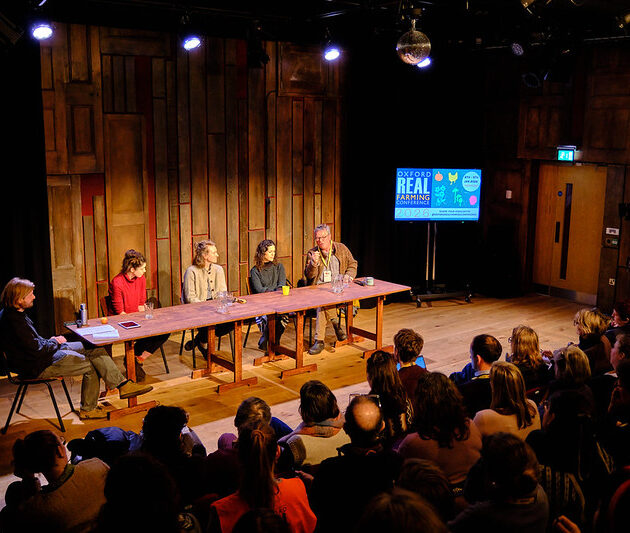
The Oxford Real Farming Conference is an annual event that attracts people from across the spectrum of sustainable farming and food production, focusing primarily on agroecology. Initially set up to offer an alternative to the Oxford Farming conference, which takes place at the same time, it aims to include and explore a wide range of perspectives and approaches.
The session I would participate in, ‘The demise of plant-based meat: cause for celebration or concern?’ was one many of the people I spoke to were interested in attending. It was clear that the broad objectives of everyone at the conference had large areas of overlap – especially regarding the problems with intensive animal agriculture – but there was a spread of opinions on how best to achieve them, and in particular on what role, if any, plant-based meat should play.
The panel
The conversation kicked off with opening statements presenting the diverse perspectives of those on the panel, after which it continued in a free-flowing format, expertly chaired to allow exploration while still covering the important topics.
Chair: Rob Percival, Head of Food Policy at the Soil Association and author of the Meat Paradox
“Plant-based alternatives to industrial meat are obviously superior in certain respects. They’re more ethical and environmentally benign, for example. But if demand was to significantly scale, what sort of food system transition would this drive? Is there a risk of corporate capture, wherein the meat lobby simply buys up plant-based manufacturers, or can these products help drive more systemic change? In focussing on highly processed alternatives to highly processed meat, do we risk entrenching unhealthy dietary preferences, or are these products a necessary ‘stepping stone’ towards a more minimally processed plant-rich diet? These are the big questions, and there are no simple answers.”
Nikki Yoxall, Technical Director at Pasture for life, and founder of Grampian Grazers
“Declines in processed plant-based meat substitutes are real in the UK retail environment, but that’s not the same as people eating better diets.
Ultra-processed foods dominate UK diets and evidence, including UK cohort studies, clearly links high UPF intake with worse health outcomes like obesity. The agroecology movement should welcome reduced reliance on ultra-processed products of all kinds and champion accessible, whole, minimally processed foods; whether plant- or animal-derived. Policies should be aimed at structural shifts in the food system, not just substituting one ultra-processed product for another.”
Rebecca Tobi, Head of Food Business Transformation at the Food Foundation.
“The evidence is clear. We will simply not be able to meet climate and health goals in the UK without shifting our diets away from our current heavy reliance on meat. We need to eat less and better meat, and more plant-rich diets. While ideally this shift would include more minimally processed plant foods such as beans and wholegrains (which bring the biggest co-benefits for health and the environment) we also need to be pragmatic about what is feasible and realistic to ask of citizens.
Plant-based meat alternatives can be a really helpful stepping stone for many meat-eaters to support them to eat less meat without them having to radically change their typical shopping and cooking habits. While health concerns have dogged the plant-based sector of late, it’s important to remember that a third of the meat we eat in the UK is processed and strongly associated with an increased risk of cancer. When the Food Foundation analysed 68 different plant-based products, we found no evidence that the nutritional profile of plant-based meat alternatives is on average notably worse than for meat products. The emerging evidence looking at the health impacts of different types of UPFs supports this, with ultra-processed animal products having much more of an impact on negative health outcomes than ultra-processed plant-based products. We really need to start having a more nuanced conversation when it comes to plant-based meat alternatives.”
Hugh Fearnley Whittingstall, BAFTA-winning writer and broadcaster who focuses on public education around sustainable and ethical food. He has written books and presented TV series and campaigns on industrial farming, overfishing, unhealthy diets, plastic and food waste. His latest book, How to eat 30 plants a week, focuses on making cooking with plants, beans and pulses more accessible and delicious.
Alongside this illustrious panel, I was there to share perspectives stemming from my work at GFI Europe, unpacking the evidence on plant-based meat and nutrition. The position I presented is outlined below.
To hear the full discussion and the complete viewpoints of my fellow panellists, check out the recording at the bottom of the page, and explore more of the sessions at the 2026 Oxford Real Farming Conference on their website.
Why plant-based meat has an important role to play in the shift to a healthier, more sustainable food system
The case for plant-based meat is fairly straightforward: unless healthier and more sustainable options can compete with processed meat from intensive farms, we can’t hope to disrupt industrial animal farming.
Intensive animal agriculture is growing fast. I grew up in one of the biggest chicken-producing areas of the UK where that growth is hard to ignore. In Powys where I live, there were two million chickens when I graduated from high school. Today there are 10 million.
Ten million chickens produce a lot of waste. That waste has caused untold damage to local rivers like the Wye, a site of special scientific interest, which has recently entered major decline due to pollution driven by the expansion of intensive chicken farms.
More broadly, 80% of the UK general public are ‘strongly opposed’ to factory-farmed meat. Yet they often have little choice but to eat it: so many people in the UK struggle with the cost of living, with busy lives and fussy kids, and intensive meat offers them food that is affordable, tasty and familiar. It is also hard to avoid. Avara foods is a joint venture of the US meat giant Cargill, and owns the farms, feed and factories driving the explosion of chicken farming along the Welsh borders where I live. It is also the primary supplier of several of the UK’s biggest retailers and restaurant chains.
To date, plant-based meat has proved one of the most effective approaches to expanding the audience for plant-based foods by giving people an option that fits into the same meals and offers a familiar eating experience. It is by no means a silver bullet, but it is particularly well placed to support people who want to eat more plants and less and better meat, but don’t know where to start. To counter the rapid expansion of industrial meat, we need to expand ways of ensuring healthier and sustainable options are similarly tasty and affordable. This can complement broader approaches to expand uptake of other plant foods like legumes, pulses and wholegrains.
Beyond far less pollution, plant-based meat also requires fewer inputs and less land than industrial meat, meaning it can also help make space for wider use of agroecological approaches.
If plant-based meat is so promising, why have UK sales declined?
While sales of plant-based meat have attracted a far larger audience than more traditional plant protein foods like tofu in a much shorter time frame, the UK has seen sales start to fall in recent years – even while they have continued to grow in other countries like Germany, France and Italy.
Two key factors in this are likely cost, and the very polarised nature of the discourse in the UK around ultra-processed foods.
Plant-based meat is very different to the average food in the UPF category. It generally has a good nutritional profile – particularly when compared to the processed meat it often replaces. It uses less land and produces less pollution, and it is generally made by a more diverse range of less centralised companies. It also makes up less than 0.5% of calories eaten in UPF studies.
And yet, regardless of this, the UPF discourse means plant-based meat is often lumped together with demonstrably harmful foods like energy drinks and doughnuts without a basis in evidence.
This conflation is a win for industrial meat.
Without a broad tent working to build a better system, industrial meat will continue to grow.
Advocates for healthier, more sustainable food systems often share similar goals, but they don’t always agree on the best ways to achieve them. In truth, a challenge as large and complex as this will never be solved by just one solution, and will only be overcome if many complementary approaches can pull in the same direction.
It is easy to forget that achieving these goals is not a given, and we are currently not on track. The more we allow ourselves to be divided, the less likely we are to succeed.
Plant-based meat has shown real promise, and we cannot afford to take promising solutions off the table. However, to make sure it can help contribute to an agroecological transition, we need more collaboration.
I felt privileged to be part of the discussion seeking to bridge those gaps and build a diverse alliance pushing for healthier and more sustainable food systems.
To dive into the discussion in more depth, view the full session on the ORFC Youtube channel below.
Author

Amy Williams
Amy oversees GFI Europe’s digital channels and works to build accessible, evidence-based resources on protein diversification and nutrition.