
The base is strong, now it’s time to grow: how 2025 set the stage for the next phase of Europe’s protein transition
Dieser Artikel ist hier auch auf Deutsch verfügbar.
2 December 2025

The hundreds of rings inside old Beech trees reveal a mix of thick rings made of softer wood from some years, and thinner, denser rings from others. This is because, while they may grow bigger and faster in warm years when the sun shines and the rains are abundant, these are not necessarily the years they make their strongest wood. In fact, without the slower, more resilient growth of earlier years spent beneath the canopy of larger trees, they are weaker and more susceptible to storms and other environmental stresses.
In the world at large and for alternative proteins, 2025 has been a year of turbulence. Beneath the surface, however, the European alternative protein ecosystem has continued to mature. This year, GFI Europe’s work has sought to consolidate and strengthen the scientific, industry and policy foundations of plant-based, fermentation-made and cultivated meat in Europe, setting up a robust basis for sustainable growth.
Setting up the next phase of protein diversification
It’s safe to say the environment for green technologies worldwide has changed in recent years, with economic slowdown, rising geopolitical tensions and burgeoning misinformation all compounding to slow the initial explosion of growth in the late 2010s. Alternative proteins have been no exception. Rising costs and a more uncertain environment for private investment have posed a challenge for many alternative protein startups, who have less insulation than more established players to weather the market shocks.
Attacks on plant-based foods in Europe have also overshadowed the policy sphere. Plant-based labelling restrictions, initially defeated in 2020, were resurrected by EU policymakers and supported by the European Parliament, paving the way for bans on the use of meaty names for plant-based foods.
Misinformation is also prevalent, particularly in discussions about nutrition, with plant-based meat sometimes being tarred with the same brush as ultra-processed foods, often without solid evidence.
The strong fundamentals beneath the surface
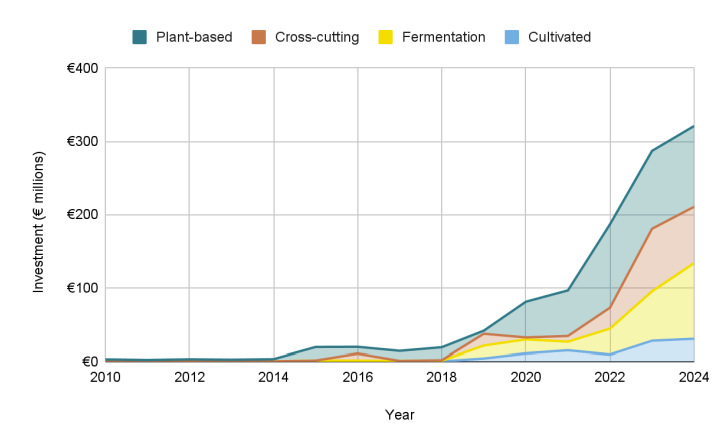
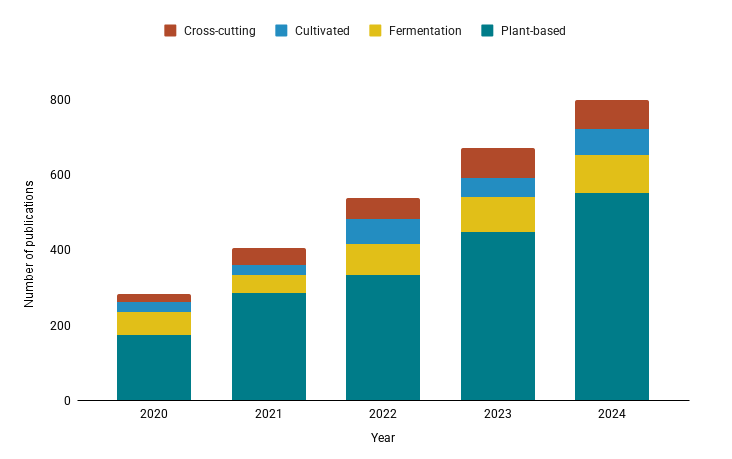
But these surface-level challenges don’t tell the full story. Where private investment has faltered, public investment in science has continued to grow. Our latest reports on the scientific funding and publishing ecosystems revealed that alternative protein research has nearly tripled since 2020, with almost 800 academic papers published in 2024 and public funding increasing from €80 million to over €320 million.
Growth in public funding and publications per year by alternative protein pillar in Europe
While private investment is undoubtedly important, it is not sufficient on its own. Open-access research supported by public and nonprofit funding accelerates the pace of progress for the entire sector by making the latest advances accessible to all.
Europe is also home to world-leading alternative protein research hubs – sparking impactful collaborations and supporting advancements globally. Even in our research grant programme, the strength of Europe’s research is plain to see: 12 projects received grants in this year’s programme, 8 involve researchers at European institutions.
The field is increasingly taken seriously by leading European universities looking to inspire the next generation of researchers, with 2025 marking the announcement of the world’s first-ever master’s course by the Universidad San Pablo CEU in Spain.
Much of this progress will be accelerated by GFI’s recent acquisition of cell lines from SciFi Foods – the starter cells that can be used to cultivate meat without the need to raise animals. These cell lines normally take years and millions of euros to develop, but GFI has made them publicly available to researchers worldwide. By doing so, we’re removing a key barrier to entry and opening the door to lower costs and faster scientific progress across the whole field.
Putting this into practice
The scientific foundations for alternative proteins are stronger than ever. What remains is to translate these fundamentals into real-world impact by putting plant-based and cultivated meat on people’s plates.
This year, GFI Europe partnered with Plant Futures and consultancy firm HarrisX to understand what consumers in the UK and Germany actually want to eat. The results were positive: around half of people in both countries want to eat more plant-based foods or reduce their meat intake. But they still face barriers around taste, price, and confidence in cooking.
We shared these insights with food companies and retailers to help them develop products that go beyond the traditional audiences for these products (eg vegetarians) and truly appeal to everyone. Our recommendations to the industry include improving flavour and affordability, creating easy-to-use recipes, and targeting products at audiences ready to make the shift.
Our research partners at Plant Futures Collective have also been using the poll results to engage directly with Tesco, Sainsbury’s, Ocado, and Waitrose (leading UK supermarkets), as well as most of the leading plant-based brands. Tesco is using the data alongside their Clubcard insights to target the right shoppers with deals, boost visibility in stores, and even featured a “Meat Free Made Easy” double-page spread in Tesco Magazine. Sainsbury’s is doing something similar with its Nectar data, focusing on people who are open to reducing meat but not cutting it out entirely.
Plant Futures shared with us that these achievements wouldn’t have happened without GFI Europe, showing the tangible real-world impacts that our donors have made possible.
While these insights are helping companies meet genuine demand, misconceptions around plant-based foods – including the UPF debate – continue to alter public perception. In Germany, this discussion has been less prone to hyperbole and remained more nuanced, and uptake continues to grow; in the UK, the narrative has been harder to shift.
Building defences against misinformation
According to the World Economic Forum’s global risks report in 2024, misinformation is a major global threat, with particular relevance for public health and nutrition. This is an area where alternative proteins have been caught in the crossfire, particularly in conversations about ultra-processed foods (UPFs).
In recent years, media coverage and social media influencers have implied that plant-based meats have similar health impacts to fizzy drinks or hot dogs. However, the evidence does not bear this out. Instead, it finds that plant-based meat offers several advantages over the processed meat it typically replaces, ranging from improved heart health to better weight management.
We set out to unpack the evidence and lay down a solid foundation for wider collaboration and nuance on the topic of alternative proteins and UPF.
In partnership with the Physicians Association for Nutrition, we conducted a comprehensive literature review into the research and narratives around both UPF and plant-based meat. It helps dispel myths about processing and highlights the real nutritional and environmental benefits of plant-based meat, providing decision-makers with reliable evidence to work from.
The findings were clear. Plant-based meat has very little in common with the average food in the UPF category from a nutritional perspective. And if plant-based products feature at all in studies assessing the nutritional profile of UPFs, they make up only a tiny fraction of what people actually eat, meaning they don’t meaningfully influence the overall results. Where UPFs tend to be high in saturated fat, salt and sugar, and lacking in fibre, plant-based meat is, on average, low in saturated fat and sugar, high in protein and a source of fibre.

Meanwhile, processed conventional meat, which plant-based meat typically replaces, is one of the UPF subgroups most strongly associated with harm. And yet, fears around UPF are frequently used to attack plant-based meat without a basis in evidence.
From this new baseline of understanding, made possible by our fantastic family of donors, we have already begun to build collaborations.
Throughout the summer and autumn, our Nutrition Lead, Amy Williams, contributed to the development of the EAT Lancet 2.0 community for action guidelines for healthcare professionals, and participated in the webinar series hosted by TABLE, supported by the UK Food Standards Agency and the United Nations Foundation, on alternative proteins and nutrition.
Setting up strategies to support sustainable growth
Alternative proteins offer opportunities to support health and sustainability while delivering green growth – a top priority for governments with the power to propel the sector to impact.
We began 2025 with the launch of a landmark report from Systemiq, commissioned by GFI Europe, on the environmental and economic potential of alternative proteins in Germany. The report found that the sector could contribute €65 billion to the German economy by 2045 and create up to 250,000 new jobs. Data from this research was shared with over 600 stakeholders across politics, research, and industry, and was cited in the recommendations of Germany’s independent Scientific Advisory Board on Agricultural Policy, Nutrition and Consumer Health (WBAE).
A similar story was uncovered in the UK, where we supported further work by Systemiq to unpack the potential of fermentation.
As well as making a compelling case for investment in research and scale-up, this evidence enabled alliance-building and collaboration with trusted civil society actors, including the Food Foundation and Green Alliance. Together, we co-created the Low Hanging Fruit policy pathway, identifying quick wins to improve the UK food system, and submitted recommendations to inform the upcoming UK Food strategy.
This year, we released our first-ever ecosystem report for Spain, mapping the country’s cutting-edge science, startups, and innovation landscape. Alternative proteins were also recognised in Spain’s national food strategy for the first time, as one of the most important agrifood trends.
GFI Europe supported the Ministry of Agriculture throughout this process, providing evidence on the contribution of alternative proteins to nutrition, sustainability, and innovation. We received feedback that our holistic overview of Spain’s ecosystem, along with our tailored, practical recommendations, was particularly valuable in shaping their approach.
This report was just one of the many open-access resources we produced this year – helping to write the roadmap to mainstream adoption. Tailored to specialist and technical audiences, our report on innovative financing mechanisms and our briefing on the opportunities offered by blended finance from public and private sources were met with positive feedback from industry stakeholders.
From strong foundations, our impact can grow
As we reach the end of 2025, the green shoots of the next stage of progress for alternative proteins are already beginning to appear. In October, French company Parima became the first-ever European cultivated meat company to receive regulatory approval, with its cultivated chicken given the green light in Singapore. In November, early numbers from the UK suggest chilled plant-based meat sales returned to growth in 2025, amid more competitive pricing and the expansion of ranges in affordable retailers such as Lidl.
While 2025 has been defined by turbulence and uncertainty around the world, our progress this year has bolstered the European ecosystem for years to come. With the support of our donors, we’ve focused on building strong, resilient foundations to support long-term progress for alternative proteins across Europe. From understanding the complex dynamics underpinning shifts towards sustainable eating to building alliances against misinformation and evidencing alternative proteins’ potential for both the environment and the economy, our work has strengthened the field and built momentum.
We’re privileged to have the support of a generous and dedicated family of donors who share in our mission, without whom none of this would be possible. We’re excited to see what 2026 has to offer and to grow from these foundations.
Author

Emily Johnson
Emily builds relationships with donors in support of GFI’s global mission to make sustainable proteins the default option.