
Tofu and beans are having a moment. What does this mean for efforts to build a more sustainable food system?
The growing interest in tofu and pulses is good news. But is this enough to ensure that healthier and more sustainable diets become mainstream?
Dieser Artikel ist hier auch auf Deutsch verfügbar.
Este artículo también está disponible en español.
23 July 2026
If plant-based foods are to fulfil their potential to help build a more sustainable and resilient food system, they need to fit into people’s everyday diets.
While plant-based meat saw strong growth for several years, some countries have seen sales begin to falter recently, with the conversation turning towards more traditional plant protein options like tofu and legumes.
In line with this trend, brands known for their plant-based meat options, like France’s La Vie, the Netherlands’ Vivera, Slovenia’s Juicy Marbles, and the UK’s THIS, have diversified their offerings beyond products that replicate the taste or texture of meat.
Whole foods are also having a moment, with the Worldchefs culinary network declaring that beans, lentils and chickpeas are among the key trends to watch in 2026.
It is great to see these foods attracting more attention and recognition for the role they clearly have to play in building healthier and more sustainable dietary patterns. But the prevailing discourse that people don’t want plant-based meat, and that whole foods and tofu are the only solution, is detached from what we see playing out in the real world.
While it is certainly true that tofu and tempeh sales have grown significantly compared with a few years ago, the market remains tiny in terms of volume. The real benefactor of the faltering growth in plant-based meat is industrial meat production.
Taking the pulse
It’s exciting that chefs are creating genuine buzz around pulses, as long-standing government efforts to promote them have had limited impact.
In Spain, where pulses were at the heart of the traditional Mediterranean diet, there has long been a push to re-engage the public with beans and lentils. Yet while total pulse consumption grew by 11% in Spain from 2011 to 2025, the average person still eats less than a third of the 11.5kg per year recommended in the country’s national dietary guidelines.
Germany has been promoting pulses as part of its protein crop strategy since 2012 and emphasised the importance of legumes in their 2024 food strategy. Despite this, annual consumption increased by just 2% over the last 15 years, and the average German still eats less than half the German Nutrition Society’s annual recommendation of 6.5kg.
Euromonitor data shows the volume of dried and shelf-stable pulses sold across Europe grew by 19% between 2011 and 2025, and by 2% in 2025 itself – so the direction of travel is positive.
But the pace isn’t nearly fast enough for legumes alone to address the challenges facing the food system. When it comes to protein diversification, the only metric that truly matters is meat consumption, which is continuing to rise.
Data from Euromonitor also shows the total volume of meat sold in Europe grew by 1.1% last year, with increases in France (+0.4%), Germany (+0.3%), Italy (+0.6%) and Spain (+2.2%). That’s small in percentage terms, but even with similarly small decreases in the Netherlands (-0.2%) and the UK (-0.7%), this still represents growth of 544 million kg across Europe during 2025, whereas the volume of dried and shelf-stable pulses grew only 75 million kg.
Tofu takes centre stage
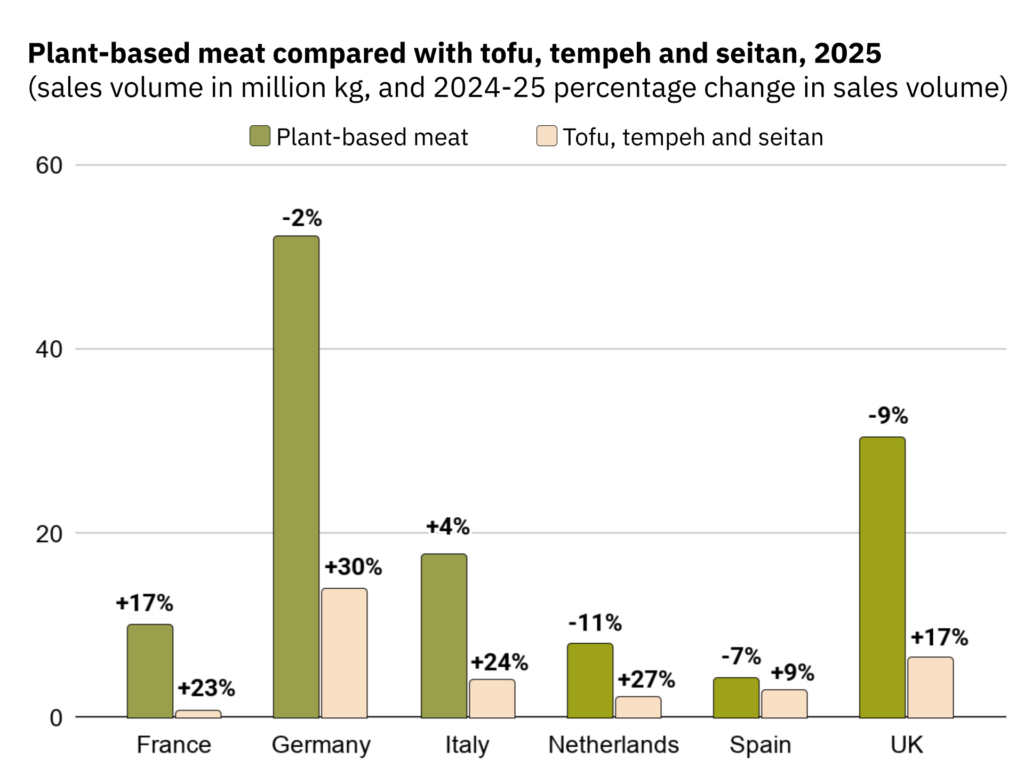
GFI Europe’s latest analysis of Circana retail sales data across six major European markets revealed that sales of tofu, tempeh and seitan are growing rapidly.
In 2025, sales volumes increased by 30% in Germany, 27% in the Netherlands, 24% in Italy, 23% in France, 17% in the UK, and 9% in Spain. Separate data from Plant-based Food Finland shows that tofu sales were up 12% and tempeh nearly 40% in Finland over the same period.
This growth is encouraging and is likely to be driven in part by affordability, with the price of tofu ranging from 20% cheaper than plant-based meat in the UK to 62% cheaper in Spain.
But it’s important to put this trend into context. Tofu, tempeh and seitan represent a much smaller market than plant-based meat, despite the significant price gap.
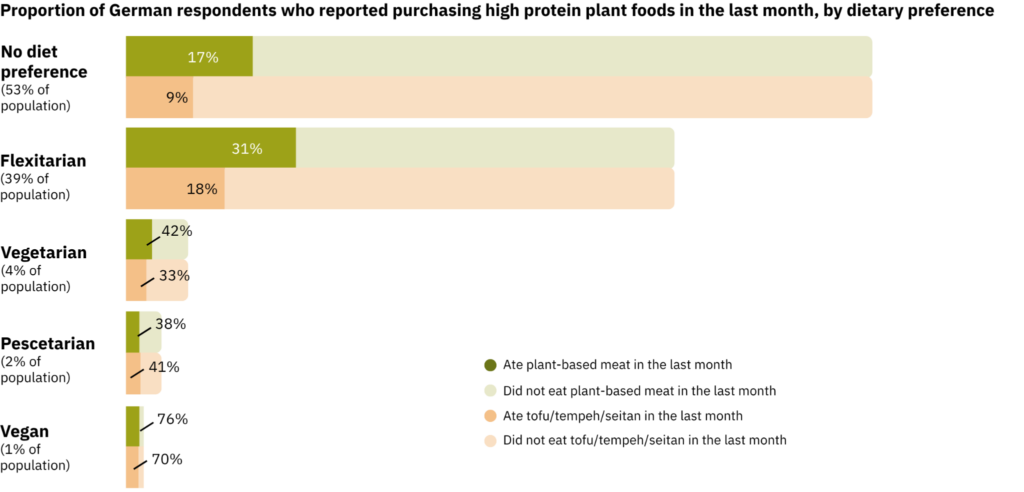
GFI Europe’s consumer research with HarrisX and Plant Futures suggests that tofu, tempeh and seitan perform well among vegetarians and vegans, but have a more limited reach among flexitarians and meat eaters. More than a third of vegetarians said they had eaten these foods in the last month, compared with 13% of flexitarians in the UK, 18% of flexitarians in Germany and only 9% of meat eaters in both countries.
The figures suggest that plant-based meat has broader appeal. Around 30% of flexitarians in both countries said they had eaten plant-based meat in the last month, as well as 14% of meat eaters in the UK and 17% in Germany.
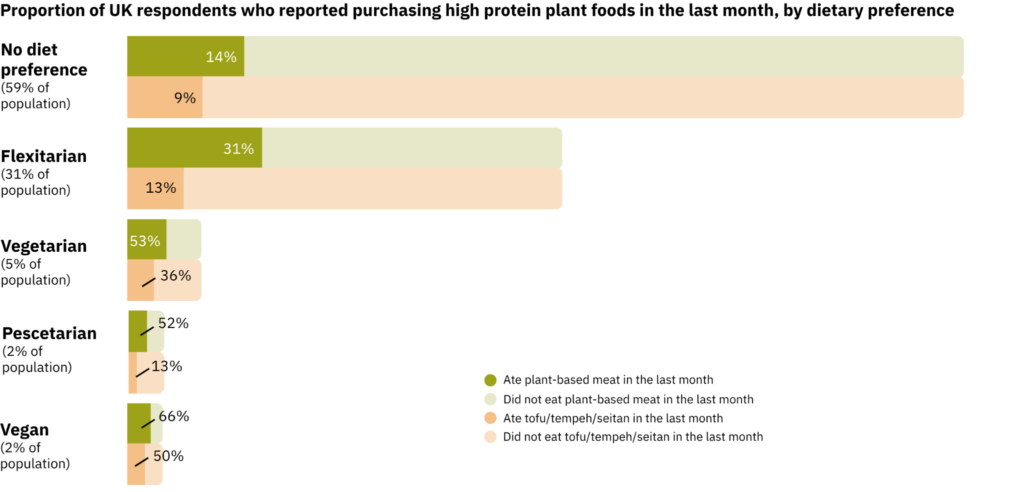
Meanwhile, separate NIQ Homescan data published alongside our retail sales analysis found that 31% of all German and UK households bought plant-based meat at least once in 2025. This suggests that the potential for mainstream adoption is there, although it will need investment and support to translate this interest into regular purchases among meat eaters.
Learning lessons from plant-based milk
Our consumer research found that people who wanted to eat more plants and/or less meat were looking for options that felt familiar and easy to cook.
Experimenting with new plant-based recipes works for some, but many people across Europe have busy lives and fussy kids, and find it easiest to integrate plant-based foods when they slot into a familiar meaty meal.
The success of plant-based milk – which now makes up 8-10% of all milk sold in Dutch, German, Italian and Spanish retailers – shows that options that play the same role as animal products can gain ground if they are affordable and high-quality.
Barista-style products, designed to froth and be added to coffee, now make up around one-fifth of the range of plant-based milk products available in Germany, more than a fifth of the category’s sales volume in the UK, and more than 30% in the Netherlands.
The popularity of this format demonstrates the potential of products that are intended to replicate the taste and functionality of animal-based foods.
Making plant-based the easy choice
Europe’s overreliance on industrial meat production is driving climate change, air and water pollution, public health challenges, and dependence on increasingly volatile global supply chains. Diversifying our protein supply will be essential for building a more sustainable and resilient food system – but for it to work, plant-based foods must be the easy choice.
Growing interest in beans, tofu and other plant-forward foods is good news, and no single solution will fix the current problems with our food system. Options that match the taste, price and familiarity of meat will be essential to make plant-based eating more appealing to those who eat the most meat.
Plant-based meat fits into people’s busy everyday lives and remains one of the best tools we have to help them shift towards healthier, more plant-forward diets without drastically changing their habits.
Civil society groups seeking to diversify Europe’s protein supply must recognise the role plant-based meat can play. And if governments and the food industry are serious about helping people adopt healthy, sustainable diets, they must support plant-based meat to deliver on its potential by investing in making it tastier, more affordable and more widely available.
Author

Carlotte Lucas
Carlotte leads our industry team, supporting the food industry in diversifying protein production, and facilitates cross-organisational projects and collaboration.