
Infrastructure investment for alternative protein production
The Good Food Institute Europe’s policy team works with policymakers, investors, and companies to close the infrastructure financing gap for alternative proteins.
Why do we need investment in alternative protein infrastructure and scale-up?
Diversifying Europe’s protein supply is essential for building a more sustainable and resilient food system, and creates opportunities to drive green growth and support high-quality jobs across the supply chain. Alternative proteins – from plants, fermentation or cultivated cells – are one of the most promising solutions to achieve this shift – but making these options affordable and accessible across Europe requires the right infrastructure and investment to produce them at scale.
By investing in alternative protein infrastructure, Europe can ensure the economic benefits of protein diversification are felt locally, and turn its world-leading scientific expertise into a thriving industry.
What kind of infrastructure does the production of alternative proteins require?
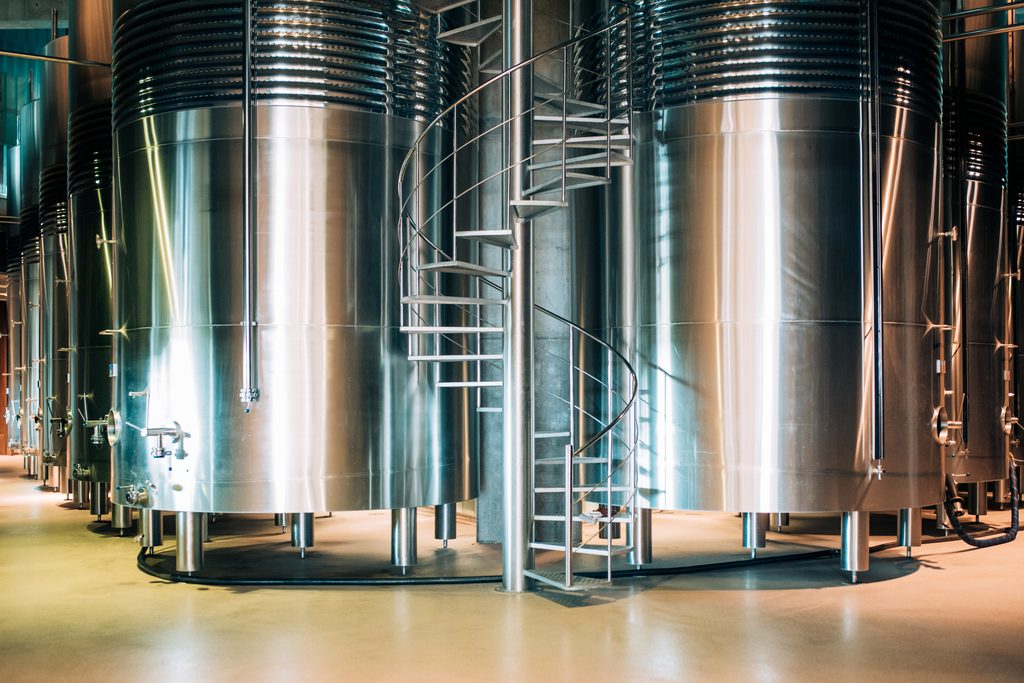
Scaling up the production of alternative proteins requires infrastructure such as:
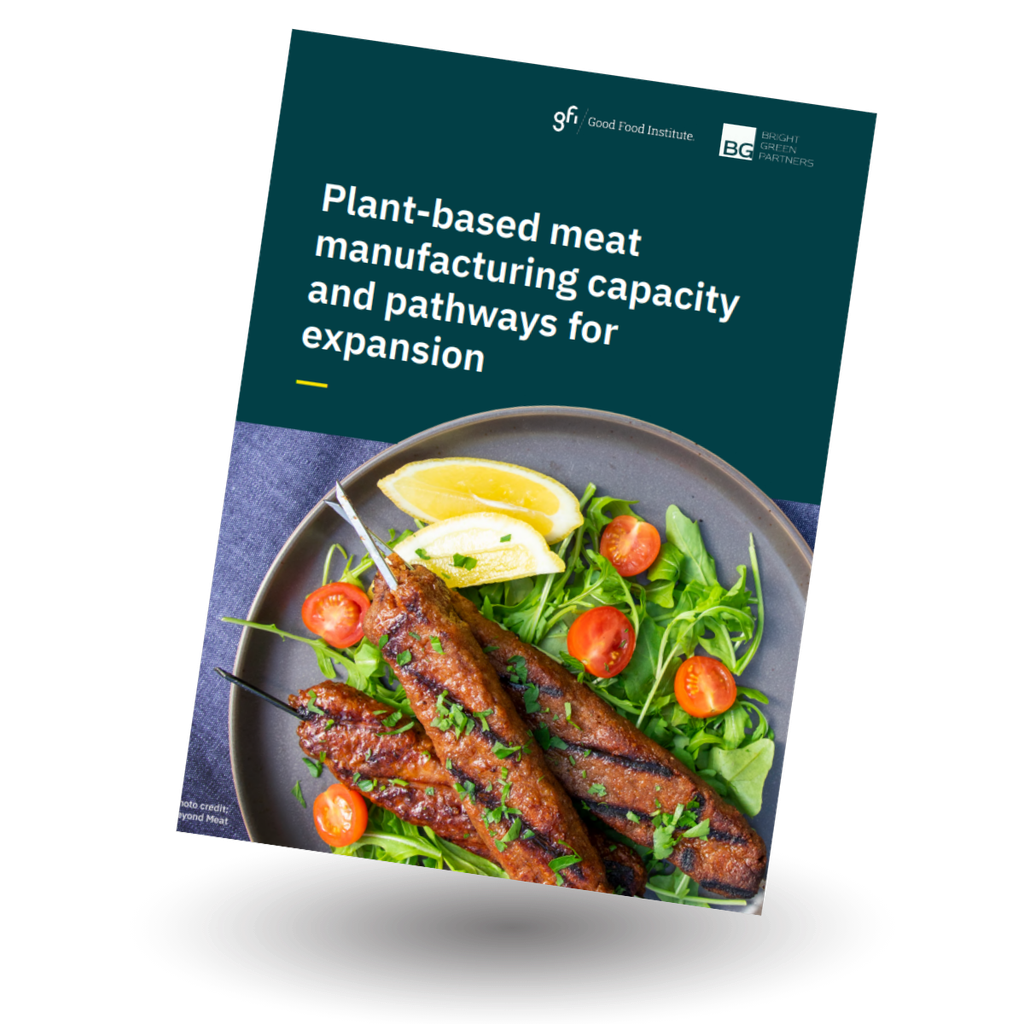
- Plant-based processing facilities to turn crops like peas, soy, or wheat into meat and dairy alternatives.
- Fermentation facilities that use microorganisms to produce protein ingredients.
- Cultivated meat pilot and demonstration facilities, where the processes for cultivating animal cells can be tested and optimised before scaling up to commercial production.
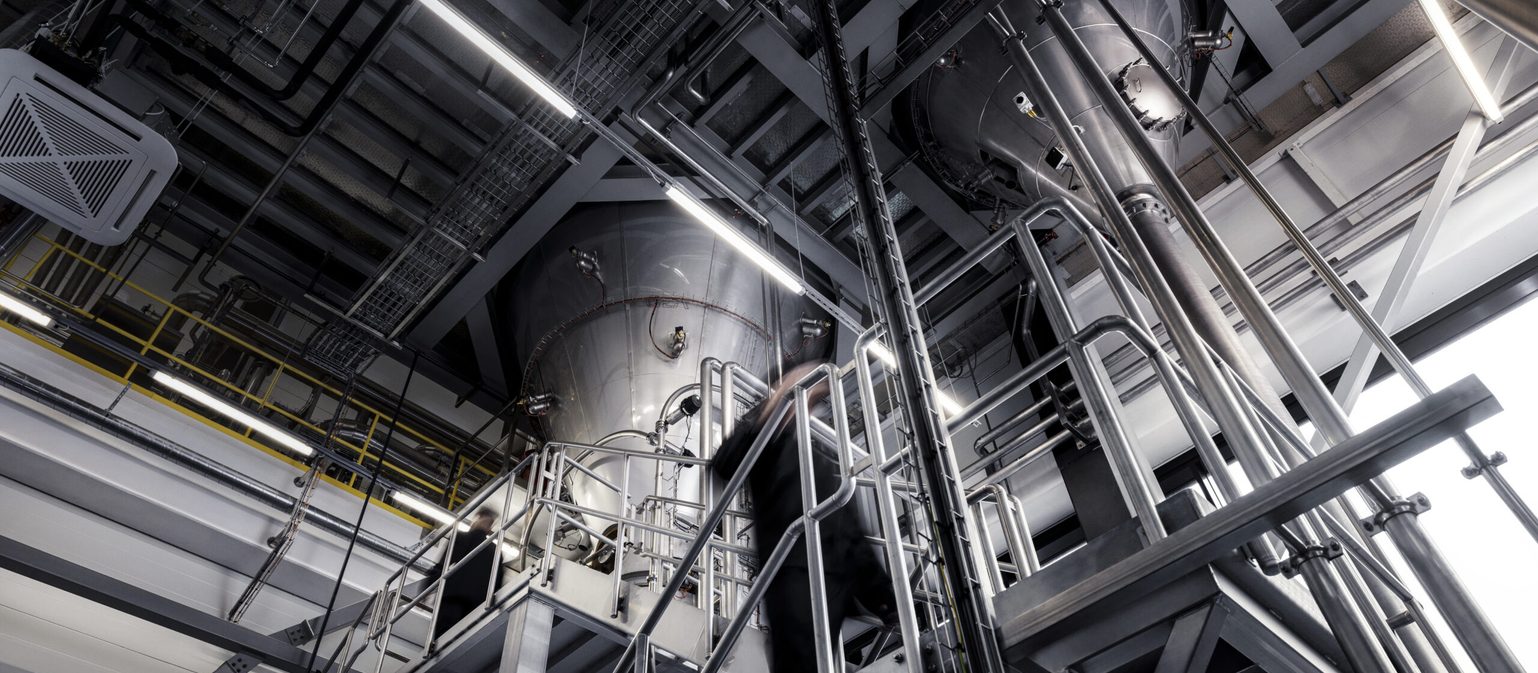
These specialised facilities are expensive. To put individual projects in perspective:
- A demonstration/pilot plant usually costs between €1 million and €20 million.
- A commercial-scale facility usually ranges from €15 million to over €150 million.
Costs vary depending on the technology, size and location. Plant-based processing facilities tend to be cheaper, while precision fermentation and cultivated meat require more specialised equipment.
What does this mean for alternative protein companies?
The alternative protein sector is dominated by small and medium-sized businesses that lack the necessary resources to finance infrastructure on their own and rely on private investors who are often reluctant to take the risk. This creates a funding gap at the moment it matters most: when a company is ready to move from proof of concept to commercial production.
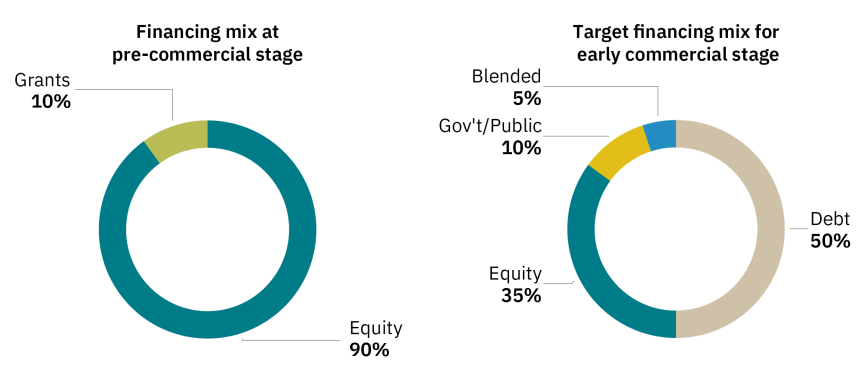
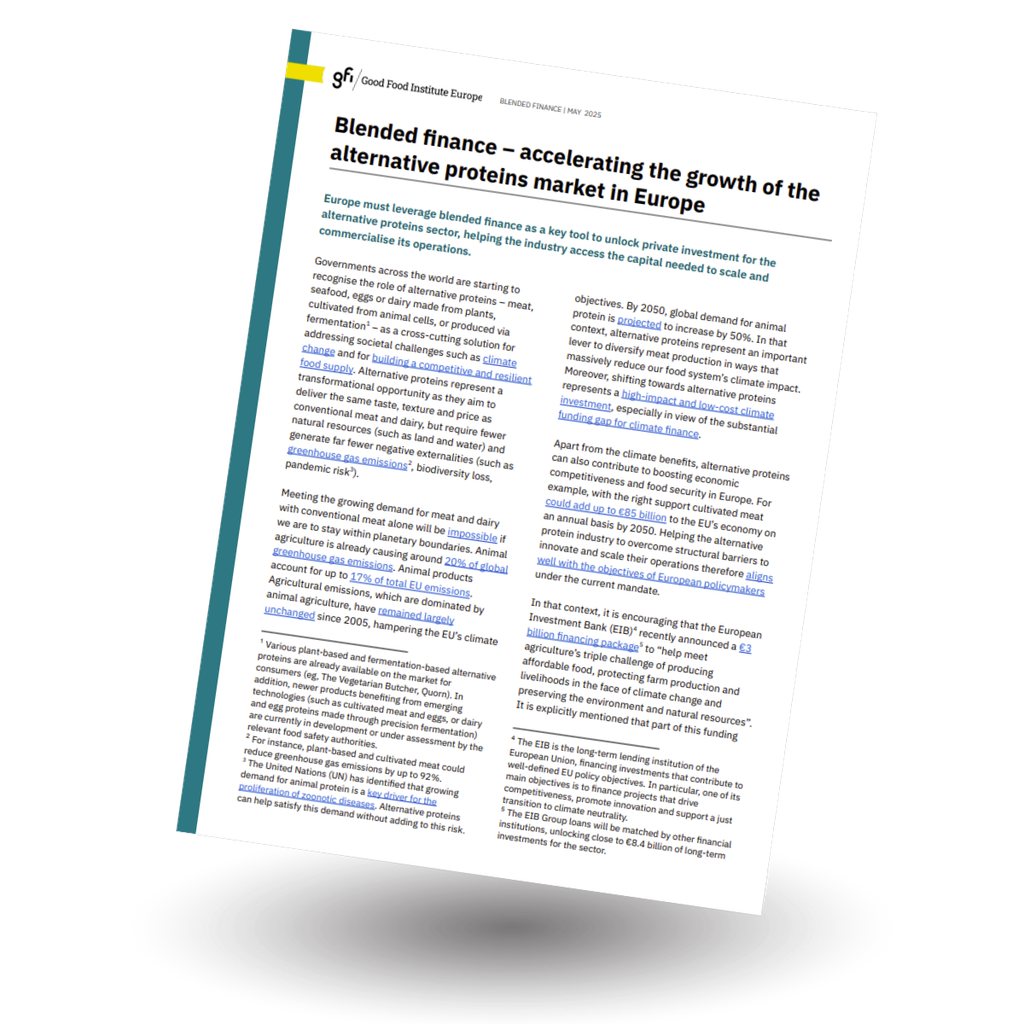
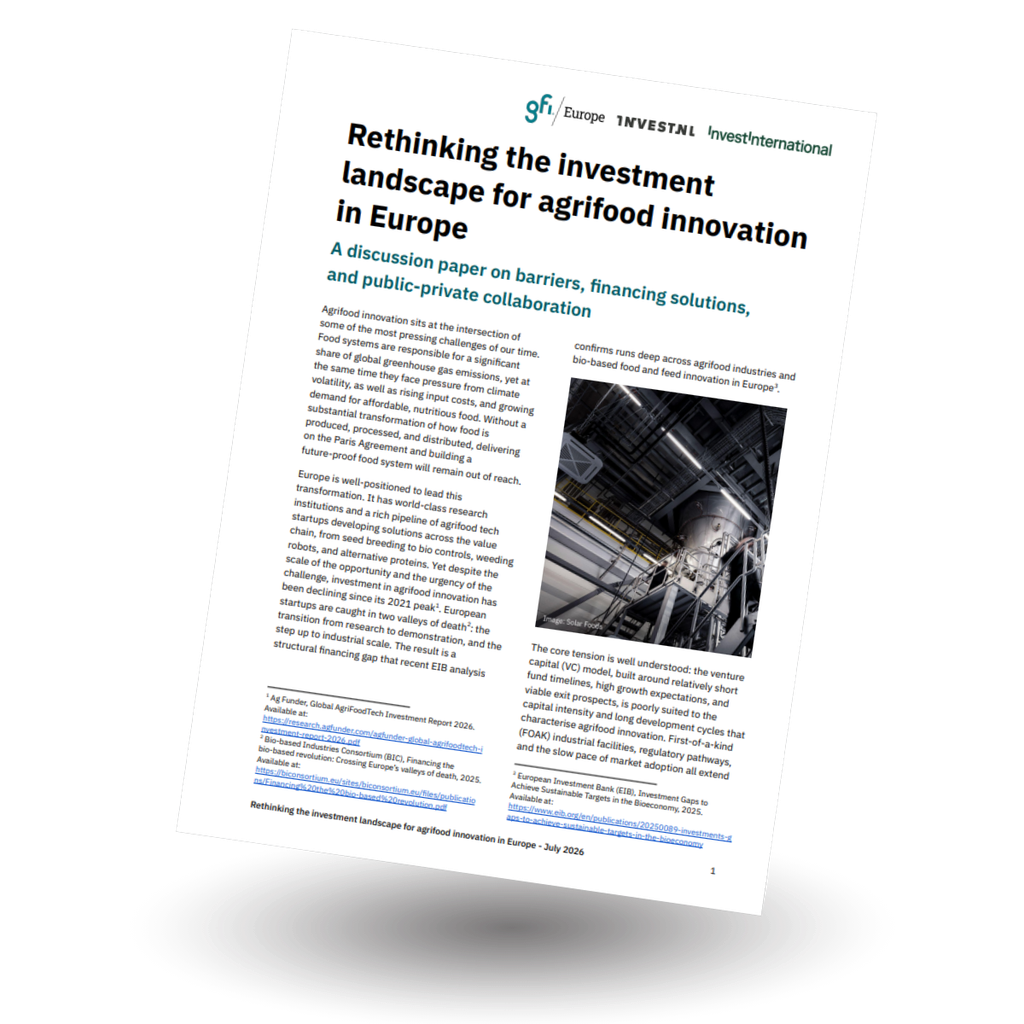
Early-stage companies often rely on grants and equity, but first-of-a-kind (FOAK) and commercial facilities require long-term debt and blended finance structures that conventional financing rarely provides.
Alternative proteins need innovative financing mechanisms built for their risk profile, with public and private investors sharing and distributing the risk in ways that make these projects viable.
Without sufficient infrastructure and access to finance, companies may delay scaling or move operations outside Europe, limiting both economic opportunities and progress towards sustainability goals.
How much investment is needed?
A recent analysis by Systemiq, supported by GFI Europe, found that alternative proteins could add €111 billion to the EU economy by 2040 – but delivering on that potential would require €2.6 billion per year in infrastructure investment.
Of that, approximately €720 million per year would need to come from public sources – not to replace private investment, but to de-risk investment.
To put this into context, this is a fraction of the total investment flowing into other green technologies in Europe. In 2023 alone, European wind energy attracted €48 billion in CAPEX investments, and the region’s solar sector attracted €55 billion.
Meanwhile, in 2024, European alternative protein companies raised just €470 million in private capital and received €63 million in public funding – a small fraction of what the sector needs.
How can European governments support alternative protein infrastructure and scale-up?
Government funding can help reduce risk and make projects more attractive to private investors. Tools such as public co-investment or guarantees can support the development of pilot and commercial facilities, and help unlock additional private capital. This kind of support has already proven effective in other sectors, including renewable energy.
Europe is well-placed to lead in alternative protein production. The continent accounts for nearly half of the world’s food-grade fermentation capacity for protein production, and over 40% of plant-based meat production capacity. This industrial base is a real advantage, but one that requires strategic investment to keep pace with the sector’s growth and competition from other world regions.
Which European governments have already invested in alternative protein infrastructure?
Across Europe, some governments are already stepping up, through a variety of instruments.
- The European Investment Bank has committed over €125 million in loans to four alternative protein companies (Matr Foods, Formo, Lantmännen and Heura), ranging from €20 million to €50 million per company.
- In Germany, MicroHarvest received a €5.5 million grant from the federal government’s energy and resource efficiency programme to build its first commercial-scale facility at the Leuna Chemical Park in Saxony-Anhalt.
- In Spain, Galicia’s first plant-based protein facility brought together €18 million in total investment, combining grants from regional development agency IGAPE, equity from its regional fund Xesgalicia, and additional loan financing from private bank Banco Sabadell.
- In Finland, Solar Foods secured a €44 million grant under the “Hy2Use” Important Project of Common European Interest (IPCEI), with a further €66 million earmarked for a second factory. Its inclusion in an industrial policy instrument designed for the hydrogen sector shows how alternative protein companies can tap into broader strategic frameworks when dedicated programmes are not yet available.
These examples show what’s possible, but they remain isolated. European governments must make better use of existing programmes and develop new financing mechanisms tailored to alternative proteins, to move from isolated examples to a coherent investment strategy and secure the competitiveness of Europe’s industrial base.
How is GFI Europe working on this?
GFI Europe works with policymakers, investors, and companies to close the infrastructure financing gap for alternative proteins, ensuring their societal benefits can be felt in Europe.
- We produce research and analysis to fill knowledge gaps on infrastructure needs and financing solutions, equipping both public and private investors with the evidence they need to act.
- We convene public and private investors to facilitate dialogue on shared barriers and solutions, helping to align interests and build the collaborative approaches that large-scale infrastructure investment requires.
- We support public investors and policymakers to include alternative proteins into industrial policy frameworks, funding programmes and financial instruments at the EU and national levels.
As a nonprofit working to build a more sustainable and resilient food system, our work is only possible thanks to our generous family donors.
Want to go deeper?
Check out our diverse resources to understand the investment and infrastructure landscape for alternative proteins in Europe.
Our infrastructure experts


Latest news
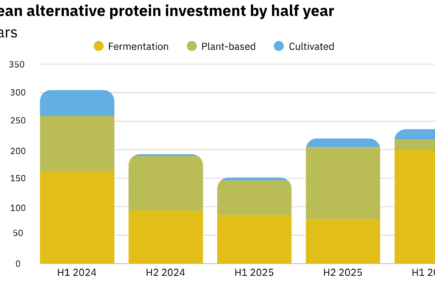
Investment in Europe’s alternative protein companies grows – but sector can no longer rely on venture capital alone
An analysis by GFI shows that fermentation companies led the pack in raising new capital in the first half of…
European alternative protein 2024 investment figures mark return to growth but show need for better funding options
The latest investment figures show European privately held companies developing plant-based foods, cultivated meat, and fermentation raised nearly $509 million…
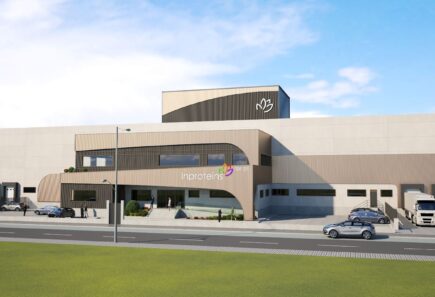
Galicia invests up to €9.5 million in public-private partnership to advance plant-based infrastructure
Galicia takes a decisive step toward sustainable food production, positioning itself as a key player in plant-based protein manufacturing through…

Biotech Heights, the public-private collaboration to boost home-grown protein diversification in Sweden
A trip to Biotech Heights, a newly launched public-private partnership initiative based in Sweden.

Europe aspires to lead in cleantech and biotech – but they need alternative proteins to win the race
It’s time for policymakers to rethink their approach, and give the same level of priority to alternative proteins as they…
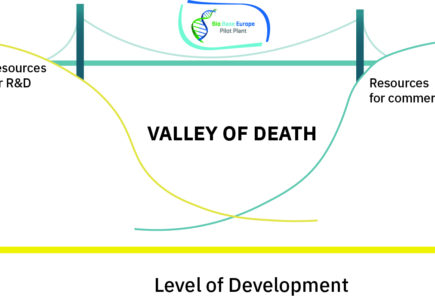
Bio Base Europe – visiting the bridge over the innovation valley of death
The ‘valley of death’ is the name given to the dangerous early period for innovations and startups after seed funding…