
Investment in Europe’s alternative protein companies grows – but sector can no longer rely on venture capital alone
The latest figures reveal that new forms of investment are beginning to strengthen Europe’s alternative protein landscape and build the capacity needed to scale.
27 August 2026
Following a summer that has seen heatwaves and drought putting pressure on Europe’s food production, and with global conflicts threatening supply chains, the case has never been clearer that we need to diversify our protein production.
Plant-based meat, cultivated meat and fermentation can play an important role in building a more resilient and sustainable food system. But while private companies and investment have so far fuelled the development of these foods in Europe, governments are beginning to step in with new forms of finance to support scale-up and deliver on their potential benefits.
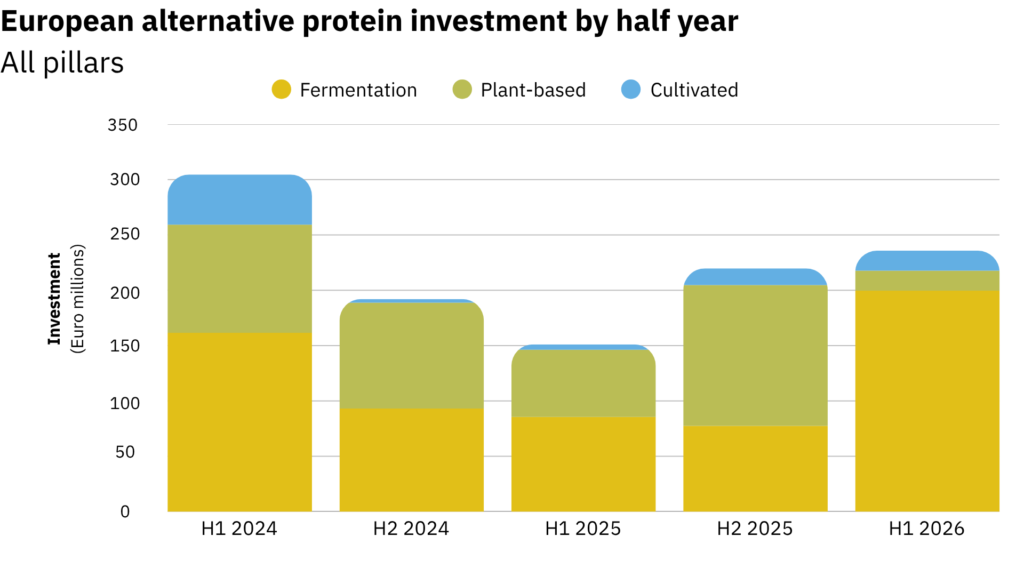
GFI’s analysis of Net Zero Insights figures* shows Europe’s alternative protein companies raised €236 million ($274 million) in private investment in the first six months of 2026 – a 56% increase on the same period last year.
The growth was led by fermentation companies, many of which also received grant funding, which can boost investor confidence and make scarce private capital go further.
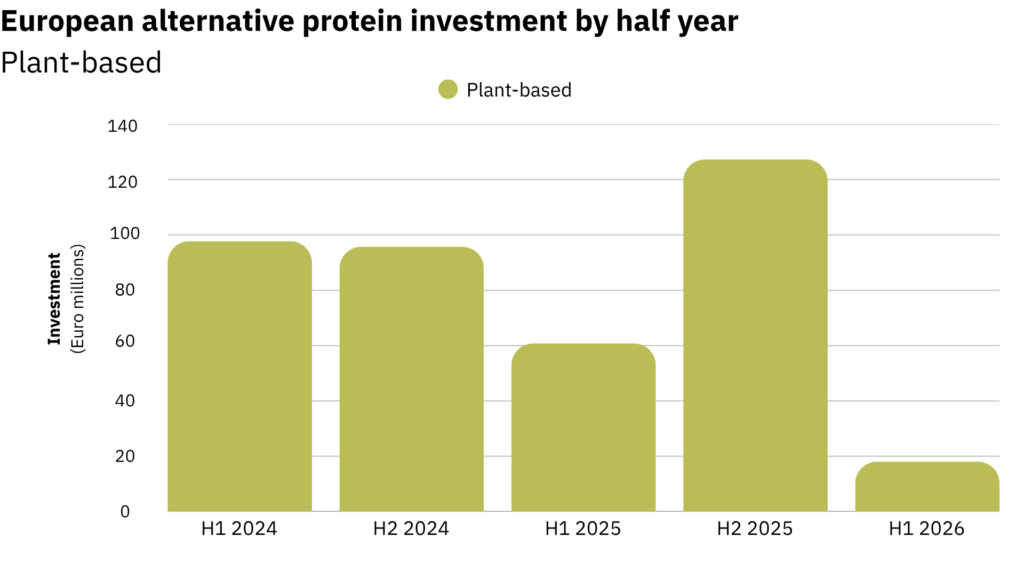
Cultivated meat investment grew slightly but remained below its 2023 peak – demonstrating a need for the sector to diversify its funding sources to secure a path towards commercialisation. Plant-based companies saw a sharp decline in private investment (though H2 2025 was particularly strong), with many companies entering the challenging scale-up phase.
The figures showed that European startups raised more than three-quarters of the sector’s global total. However, this was a larger slice of a smaller pie as global funding dropped from €341 million ($388 million) in the first six months of 2025 to €306 million ($359 million) in the same period this year.
The number of deals also halved over the same period, suggesting that increasingly selective investors are backing fewer companies. It’s been clear for some time that alternative protein startups can no longer rely on venture capital as they begin to scale production, but innovative financing approaches are beginning to emerge.
Along with Invest-NL and Invest International, we brought together more than 40 leading investors earlier this year to propose new ways to overcome the challenges faced by Europe’s agrifood innovators.
They argued that agrifood innovation doesn’t fit the usual investment mould, in which companies are expected to grow quickly and deliver strong returns within a few years. Other options, including mixing different types of funding, such as grants, loans, and equity, could spread the risk of scaling up across a wider range of investors.
Public money could also be used more strategically – not to replace private investment, but to give investors greater confidence to fund plant-based companies through the scale-up phase. The success of fermentation companies in raising grant funding for new facilities gives an indication of what’s possible.
Fermentation leads the way
Companies working on precision fermentation, which has been used for decades to produce rennet for cheesemaking and is now being used to make ingredients such as dairy and egg proteins, raised €100 million ($117 million) in the first half of 2026 – more than the €97 million ($104 million) they received throughout the whole of 2025.
Biomass fermentation companies, which produce large amounts of protein using a technique similar to brewing, raised €99 million ($115 million) – more than the €61 million ($70 million) raised last year.
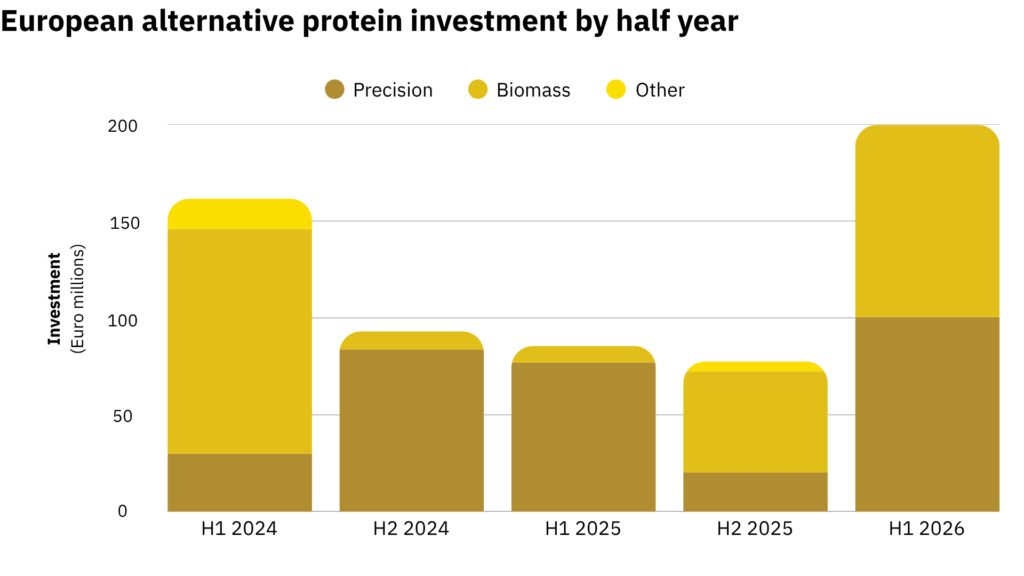
Again, the investments were characterised by fewer, larger deals, such as the €25 million ($30 million) raised by the French precision fermentation company Verley and the €18 million ($21 million) raised by Dutch biomass fermentation company the Protein Brewery – reflecting wider market trends.
Alongside this private investment, fermentation startups also brought in €67 million ($77 million) in grants – a considerable increase from the €45 million ($52 million) in grant funding raised by Europe’s alternative protein companies across all pillars combined in the same period last year.
In some cases, public investments were combined with private finance and government-backed loans:
- Solar Foods received a €78 million ($89 million) funding package from Business Finland, including a €40 million grant and a €38 million loan, to commercialise their fermentation-made protein Solein.
- The European Innovation Council Accelerator Programme provided €12.5 million ($14 million), combining a €2.5 million grant with €10 million equity, to help Dutch company Vivici scale precision fermentation dairy protein production.
- A Europe-wide consortium led by the UK’s Adamo Foods received a €10 million ($12 million) grant under the EU-funded Circular Bio-Based Europe Joint Undertaking to scale up their fermentation-made steak.
Investing in bringing cultivated meat to market
A strong theme of commercialisation ran through the largest investments in European cultivated meat companies. While some startups have closed amid a challenging investment climate, the sector as a whole raised €18 million ($21 million), slightly less than the €20 million ($23 million) raised throughout the whole of 2025.
This included Germany’s Innocent Meat raising €6 million ($7 million) to support the development of its automated production technology, obtain regulatory approval and begin construction of a demonstration facility.
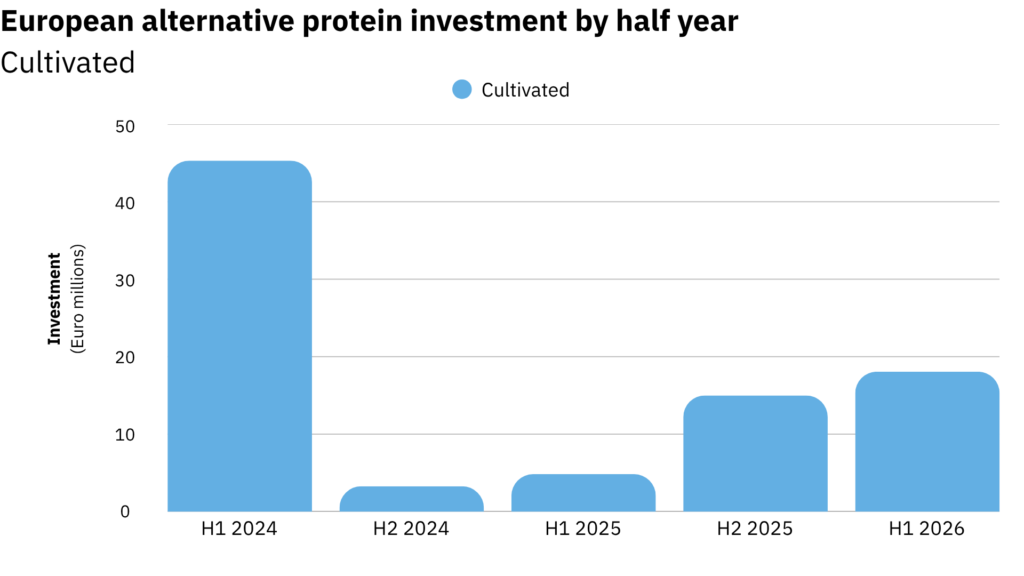
However, the sector’s largest private deal of the year so far is cultivated pet food company Meatly’s €12 million ($14 million/£10 million) for a large scale-up facility. With its faster commercialisation timelines, cultivated pet food is more suited to traditional models of private investment – whereas cultivated meat for human consumption will need public investment in open-access research, along with transparent regulatory processes, to deliver on its full potential.
Plant-based companies need new financing models to fund scale-up
European companies working on plant-based meat and dairy raised €18 million ($21 million) – a sharp drop from the €61 million ($67 million) invested during the same period last year.
In this constrained investment climate, some plant-based companies are consolidating, with smaller startups being acquired by larger players or merging with one another to reduce costs.
Others have moved beyond early-stage innovation and are trying to secure funding to move from pilot plant to industrial capacity.
Because this kind of infrastructure – urgently needed by all alternative protein producers – is still rare across Europe, investors and lenders don’t yet have sufficient prior examples to confidently underwrite the risk of making these costly investments. This means that new financing mechanisms will be essential to fund the construction of these facilities.
Too important to leave to venture capital alone
Alternative proteins could help satisfy demand for meat while using up to 90% less land, and even a modest shift could enable 21% of European domestic farmland to be used to boost domestic food production.
Providing people with tastier and more affordable plant-based meat can help them reduce their consumption of red and processed conventional meat without major lifestyle changes. Initial studies suggest this switch could reduce the risk of heart disease and bowel cancer, improve gut health and help maintain a healthy weight.
They can also enable people to eat their favourite foods without accelerating the climate crisis. Cultivated meat could reduce climate emissions by up to 92% compared with animal agriculture, and a peer-reviewed lifecycle assessment found Verley’s precision fermentation-made whey protein causes significantly fewer emissions than cow’s milk.
None of these benefits will be felt if Europe’s food innovations stay in the development phase and, with so much at stake for food security, climate goals and public health, we cannot leave protein diversification to the whims of the market.
Europe’s fermentation companies demonstrate that this kind of blended, risk-shared financing has a role. The challenge now is to expand that approach to deliver a more resilient and sustainable food system.
Methodology
Read about our methodology for analysing investments in alternative protein companies.
Conversion data
All dollar to euro conversions carried out using H1 2026’s average exchange rate of 0.8599.
Author

Helene Grosshans
Senior Infrastructure Investment Manager