The Nordics: Europe’s early leaders in alternative proteins, with potential for long-term global leadership
Together, the four largest Nordic countries have invested more in alternative protein research than the US. But without steady funding and closer collaboration, this lead won’t hold on its own.
25 November 2026
New GFI Europe analysis shows that four Nordic countries (Denmark, Sweden, Finland and Norway) are already at the forefront of alternative protein research in Europe. Their strengths in biotechnology, food science and industrial innovation provide a strong foundation for developing plant-based foods, fermentation-derived ingredients and cultivated meat. These foods can help Europe diversify its protein production, reduce the footprint of food production and make supply chains more resilient.
*Iceland is not included in this overview due to incomplete funding data.
A nascent field that is growing quickly
Alternative protein research is a young field in academic terms, but one that is growing rapidly. Since 2020, European funders have committed at least €1.3 billion in research funding, and that investment is now bearing fruit: European publications grew 60% between 2023 and 2025, and the number of European researchers publishing on alternative proteins grew by 67% on average across the three pillars over the same period.
In a field this young, research groups, funding relationships and clusters are being built now, and the countries that sustain them will shape where the field’s expertise settles. The four Nordic countries have a strong head start because their existing strengths are crucial to ensure success for alternative proteins. The region already has deep academic expertise in biotechnology, microbiology and food science, and industrial strengths in enzymes, pharmaceuticals and biorefining. Funding from governments and nonprofits has grown on this foundation since 2020, which explains why the region now leads the field in Europe.
The lead in numbers
Per head of population, the four Nordic countries punch above their weight in funding, publications and patents.
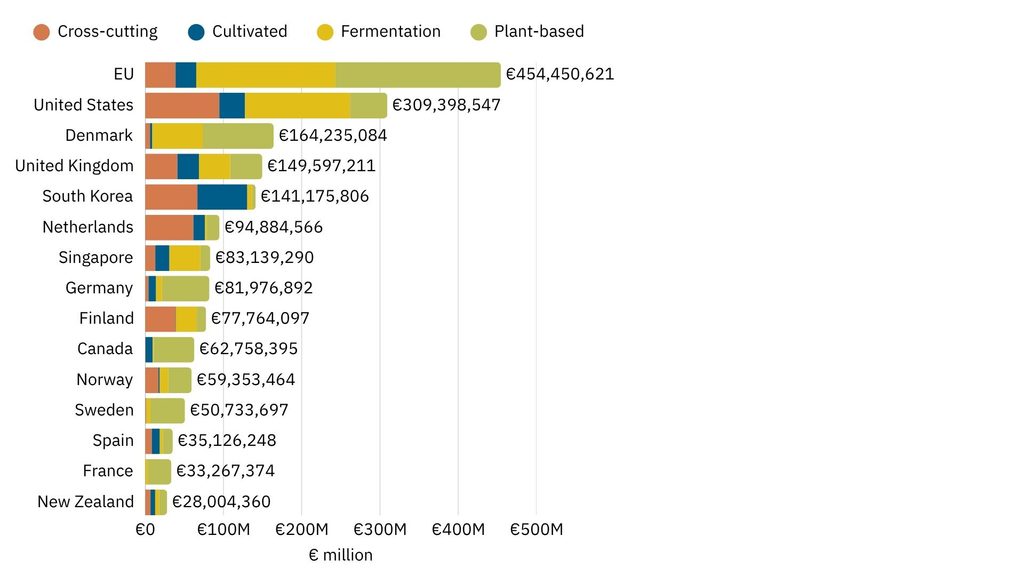
- Funding: with non-profit money included, all the Nordic countries rank among the world’s top ten funders. The Nordics combined account for around a third of European investment (€352m of €1.3bn).
- Research cluster: the region is home to 4 of the world’s 50 most productive research clusters, with two Danish and one Finnish cluster in the top 20.
- Leading universities: Around a third (7) of the 23 European universities in the top 100 most productive institutes, as measured by fractional counting of publications, are in the Nordic region.
- Talent: a quarter of Danish food scientists and a fifth of Finnish food scientists work on alternative proteins, against a European average of fewer than 11%.
- Patents: Denmark, Finland and Sweden file between 7 and 17 patent families per million people, far higher than the rates for the US (2.2), China (1.5), and the EU27 average of 2.4.
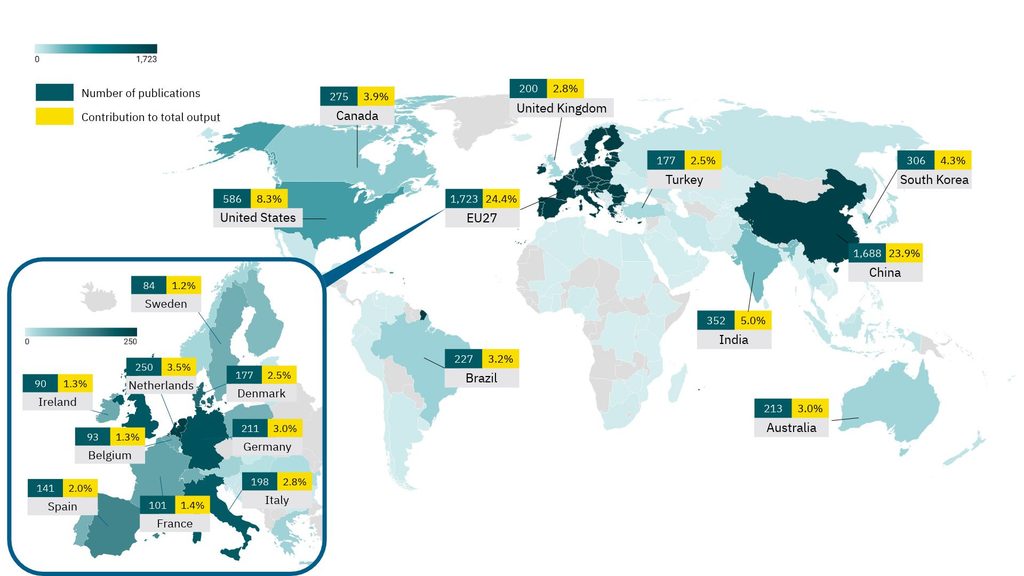
- Publications: Denmark’s 43 publications per million inhabitants between 2023 and 2025 are the highest in the world, ahead of Singapore at 31. Finland (16), Sweden (12) and Norway (8) are all well above the European average of 4.
| Nordic countries | ||||
| Denmark | Finland | Sweden | Norway | |
| Funding committed (2020-2025) | €164m 1st in Europe 2nd globally |
€78m 4th in Europe 7th globally |
€51m 6th in Europe 10th globally |
€59m 5th in Europe 8th globally |
| Funding per person | €28 1st globally |
€14 2nd in Europe 3rd globally |
€5 4th in Europe 10th globally |
€11 3rd in Europe 4th globally |
| Share of global publications 2023-2025 | 2.5% | 0.9% | 1.2% | 0.4% |
| Publications per million people | 43 | 16 | 12 | 8 |
| Publications per euro investment* | 3.1 | 0.7 | 1.2 | 0.4 |
| Patent families (2023-2025) | 104 (1.7% of global) |
56 (1% of global) |
76 (1.2% of global) |
1 |
| Patent families per million people | 17.2 | 9.9 | 7.1 | 0.2 |
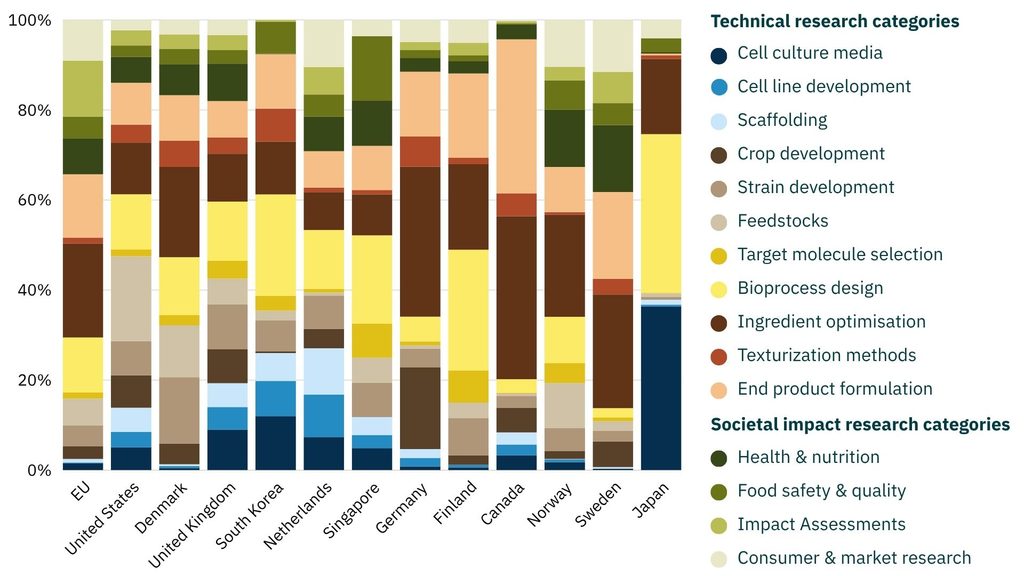
| Share of funding to technical research | 83% | 88% | 62% | 67% |
Denmark: the global frontrunner, built on philanthropy and government working together
When national and philanthropic funding are combined, Denmark is the world’s second-largest country funder of alternative protein research after the US (€164m), and by far the highest per capita: €28 per head, roughly double that of Singapore and Finland. Philanthropy made that possible: the Novo Nordisk Foundation alone provides nearly 70% of the funding awarded. The government has committed a further DKK 1.25bn (€162m) through its national plant-based action plan, which is largely not yet reflected in awarded funding. Denmark leads the world in plant-based funding (€93m) and is second only to the US in fermentation (€64m).
Our analysis shows that this investment has paid dividends. Denmark is home to two of the world’s 20 most productive research clusters: Copenhagen [9th], and Aarhus [13th], and three of its institutions (Aarhus 5th, Copenhagen 11th, DTU 12th) are in the global top 20. Danish researchers also publish the highest number of research papers per capita in the world (43 per million inhabitants), far ahead of second-placed Singapore at 31 per million, and Denmark’s global ranking for publications has climbed from 13th in 2023 to 8th in 2025. Denmark has also filed nearly twice as many alternative protein patent families (104) as Finland (56), more than its neighbour Sweden (76), and just behind the UK (110), which has more than ten times its population.
Finland: punching above its weight, with a strong technical focus
Finland punches well above its weight. Per head of population, its government spends as much on alternative protein research as Singapore and more than any other European country, and in absolute terms it ranks fourth in Europe and seventh globally, ahead of Canada, Norway and Sweden. It also directs more of its funding to technical research than any other European country (88%), with Helsinki in the top 20 most productive global research clusters (at 19th).
Around two-fifths of Finnish funding goes to fermentation and cellular agriculture, with fermentation alone taking over a third, and the dividend of this investment shows up in the number of globally successful spin-outs from VTT such as Solar Foods, Onego Bio and Enifer.
Sweden: a strong plant-based ecosystem
Sweden’s alternative protein ecosystem is solid in European terms, ranking seventh in absolute funding and fifth per capita (€5 per person). Globally, it ranks tenth in overall funding, ahead of South Korea, Switzerland, Israel and Japan.
Swedish funding is dominated by plant-based research, which accounts for 86% of the total (€45m). That makes Sweden fifth in the world for plant-based funding, ahead of the UK, and it commits more than its neighbours Norway (€30m) and Finland (€11m) combined. Swedish researchers convert that public investment into publications better than any other Nordic country, producing 1.2 publications per million euros, similar to the UK (1.1), and just behind Singapore (1.6) and Israel (1.8). The research base is anchored by the Swedish University of Agricultural Sciences in Uppsala (66th globally) and RISE in Gothenburg (97th), two of the world’s top 100 institutions. This is reflected in a competitive patent record, with 76 patent families overall, ahead of Finland (56), and 44 plant-based families, ahead of Italy (28) and the UK (25).
Norway: well-funded, with a relatively high share towards cultivated meat
Norway is the ninth-largest funder globally and the sixth in Europe. Per person, it invests €11, third in Europe and fourth globally, behind only Denmark, Singapore and Finland. Within the Nordics, Norway puts the largest share of its funding into cultivated meat (2.7%, against 1.7% in Denmark, 0.6% in Finland and 0.5% in Sweden) and has committed more than twice as much as Finland and Sweden combined, although from a low base.
Where the Nordic lead could falter
The Nordic lead is real, but it is not guaranteed. The analysis points to several weak spots that could slow progress if left unaddressed.
- In Denmark, the challenge is keeping the technical pipeline full. The €160 million plant-based action plan is a major commitment, but it covers many aims, and only a small share has so far gone to technical R&D, as the Plantefonden’s board itself has acknowledged. Ensuring steady public funding for technical plant-based research alongside the plan’s wider goals would allow public and philanthropic funding to keep reinforcing each other.
- Sweden has a biotechnology blind spot: When it comes to overall alternative protein funding, Sweden trails Denmark, Finland and Norway. Its funding is also almost entirely plant-based, leaving a gap in biotechnology-based alternative proteins. Between 2020 and 2025, Denmark invested around eleven times more than Sweden in fermentation and cultivated meat research (€67m vs €5.4m), Finland more than four times as much (€27m), and Norway twice as much (€12m). Spain and Germany also invest more than twice as much as Sweden.
- There are warning signs in Finland’s innovation pipeline: Most of Finland’s funding has been awarded in 2024 and 2025, and much of its fermentation funding supports higher TRL R&D rather than open access, foundational science. Projects starting between 2020 and 2023 received only €18m in total, and research output reflects those thinner years. Finland ranks 27th globally for publications, and 15th for patent families, ahead of Poland and Belgium but behind Sweden, Denmark and the UK. It produces 0.7 publications per million euros invested, the second lowest in Europe after Norway and well below Sweden (1.2) and Denmark (1.0). There is also a downward trend: Finland’s share of global alternative protein publications has almost halved, from 2.3% in 2010-2022 to 1.3% in 2023-2025. Today’s successful companies grew out of research funded years ago. Without steady support for early-stage, open research, the pipeline that produced them could run dry.
- Norway converts funding into research outputs less well than any other Nordic country: It has produced 43 alternative protein publications, 0.5% of the global total, ranking 39th globally and 17th in Europe. That is 0.4 publications per million euros invested, a third of Sweden’s rate and well below Finland (0.7) and Denmark (1.0). Researchers publish 7.7 papers per million inhabitants, compared with 43 in Denmark, 16 in Finland and 12 in Sweden. No Norwegian institution features among the world’s most productive research clusters and Norway has only filed one patent family, against 56 in Finland, 76 in Sweden and 104 in Denmark.
- Cultivated meat is thin across the region. Denmark lags the UK, the Netherlands, Switzerland, Germany and Spain on cultivated funding, and Danish cultivated research and patent activity is limited and inconsistent. Finland has put less than 2% of its alternative protein funding into cultivated meat-related research areas. Both countries are strong in fermentation, which shares bioprocess know-how with cultivated meat, so this is a missed chance to build on what they already have.
Turning potential into leadership
Cementing an early lead into sustained leadership requires two things.
- Make long-term public commitments. Researchers need stable, multi-year programmes, not just one-off awards or broad funding calls. The focus should be technical research in fermentation and plant-based proteins, where the Nordics already have strong foundations. Denmark can build on philanthropic leadership by directing more dedicated plant-based funding towards technical research and extending funding beyond the plan. Finland and Norway need more consistent support, rather than a few large, irregular awards. Sweden should increase its share of funding for technical plant-based research.
- Work as one region to build critical mass through joint Nordic initiatives. No Nordic country has the scale to compete alone. Denmark, the world’s second-largest funder, invests around half as much as the US when nonprofit funding is included, while Finland, Norway and Sweden rank seventh, ninth and tenth globally. Together, however, the region can punch far above its weight globally, given it has invested more than any single country (€352m), including the US (€318m). It would also rank fourth globally for publications, behind China, the US and India. Joint Nordic funding calls could turn this combined strength into larger, better-connected research communities, supporting projects no single country could fund alone. They should complement, not replace, national programmes. The need is particularly clear in cultivated meat: Denmark, Finland, Norway and Sweden invested around €5m combined, less than a fifth of the UK’s €27.5m. A shared Nordic centre of excellence for alternative proteins, with a particular focus on food biotechnology, modelled on the UK’s National Alternative Protein Innovation Centre (NAPIC), could help close this gap and build the critical mass the field needs.
The Nordics have shown what early, focused investment can achieve. Turning that head start into lasting leadership means keeping the funding flowing, widening who provides it and closing the gaps together – before competitors close in on Europe’s lead.
Authors

David Hunt
David works to help sustainable protein scientists across Europe access the knowledge, resources, infrastructure, and collaborators to conduct their research effectively.

Stella Child
Stella works to help the alternative protein research community across Europe secure grant funding for open-access research.
Benchmarking Europe’s Alternative Protein Research and Innovation Ecosystem
Read the full report to find out more about how European funding, publications and patents compare with the rest of the world.